segunda-feira, 21 de abril de 2014

Ponde e a direita festiva.


Ponde,  escreveu um artigo na Folha dessa segunda-feira que deixou um jovem amigo de esquerda injuriado. Transcrevo, abaixo o inicio do artigo, em que ele apresenta a tese defendida com seu tom costumeiro:

"Ser jovem e liberal é péssimo para pegar mulher. Este é o desafio maior para jovens que não são de esquerda.
Um dos maiores desafios dos jovens que não são de esquerda não é a falta de acesso a bibliografia que seus professores boicotam (o que é verdade), nem a falta de empregos quando formados porque as escolas os boicotam (o que também é verdade), mas sim a falta de mulheres jovens, estudantes, que simpatizem com a posição liberal (como se fala no Brasil) ou de direita (quase um xingamento).
Os cursos em que você encontra jovens liberais (economia, administração de empresas, engenharia e afins) têm muito poucas mulheres e as que têm não têm muito interesse em papo cabeça e política. O celeiro de meninas que curtem papo cabeça e política são cursos como psicologia, letras, ciências sociais, pedagogia e afins, todos de esquerda."

Pelo que leio nas redes sociais, acredito que a falta de acesso a bibliografia é um serio problema, alem, é obvio dos boicotes dos professores, mais preocupados em divulgar o seu pensamento único secular, anti-religião e anti-capitalista.  O pluralismo, palavra de ordem desta turma, significa espaço para uma versão empobrecida do marxismo e literatura anti-capitalista de qualidade similar  e  exclusão do chamado pensamento conservador   O resultado é um empobrecimento geral do debate no grande bananão.  O que se apresenta como pensamento liberal ou de direita compartilha com os seus adversarios de esquerda  a mesma pobreza intelectual.  Cenario entristecedor, porque a oferta de propostas consistentes à esquerda e à direita traria grandes beneficios a nossa democracia.

Não tenho mais 20 anos e por isto não posso avaliar a tese do Pondé. Reconheço, no entanto, que no final dos anos 70 e inicio dos anos 80, ser de esquerda, realmente era uma vantagem competitiva....


quinta-feira, 17 de abril de 2014

Robert Jenkins: Regulators’ attempts to hold back the financial tide are futile


Rain causes flooding and flooding causes damage. Which shall we blame: the rain, the river or an inadequate system of levees? Ocean tides can cause chaos along the coastline. Is the resulting devastation to nearby power plants the fault of nature or of imprudent planning and supervision? What is the proper government response? To regulate the tides and rainfall? No. Would it succeed if it tried? No. Should one focus instead on ensuring essential facilities are solidly built, properly run and protected by levees? Yes.

All obvious and logical. Yet in the area of financial regulation the authorities are flirting with the notion that they can hold back the tides. The US Office of Financial Research has identified the great ocean of capital flows as a source of systemic risk. The Financial Stability Board, which seeks to co-ordinate global regulation, is conducting a consultation with similar questions in mind. And in an otherwise thoughtful speech Andy Haldane, the Bank of England’s rightly respected head of financial stability, said this month that “modulating” investment flows “is the next frontier of macroprudential policy”.

Really? Should we not focus instead on the levees and loss-absorbing capacity of the banking system that powers our economy yet remains vulnerable to the ebb and flow of the capitalist tides?

We are working our way through the biggest credit bubble in history. All bubbles feature greed, stupidity and leverage: what sets apart the latest is the magnitude of leverage. We will not abolish greed or stupidity but we can and must address excessive leverage. Have we done so? No. Until we do, another storm will wreak havoc.

Yes, new global standards have been agreed in Basel. They tighten definitions of risk and place an overall cap on leverage. But as currently set, the rules permit bank balance sheets to balloon to 33 times their equity. At that level bank asset values need fall only 3 per cent to wipe out 100 per cent of capital. A mere 1 per cent drop leaves the institution geared 50 times; a 2 per cent fall, 100 times. How much confidence does that inspire? How long do you think bank creditors will wait around to find out? (Not long in the view of the US authorities. They just announced their intention to reduce leverage a bit further – but, alas, not by much.) Add to the mix the fact that some banks’ balance sheets are equal in size to their home nation’s output and you will grasp central bankers’ admission that we have yet to eliminate the problem of “too big to fail”.

Excessive leverage in the banking system leaves it vulnerable to collapse; authorities know this. Western governments cannot afford a rerun; treasuries know this. The public would not tolerate a repeat performance; politicians know this. So the failure to increase sufficiently the loss-absorbing capacity of the banking system risks triggering a regulatory campaign to spot and control any and all threats that might lead to bank breakdown. And when you start looking for threats you find the world of investment flows is big, complex and could overwhelm the banks’ meagre capital buffers. Then: “Gosh, we better try and control these flows.”

Well, Mr Regulator, you already control the investment industry. But, since the money belongs to its clients, you cannot control the flows – unless, of course, you are going to prevent people from selling when they want to sell and buying when they want to buy. Oh, and by the way, the funds that money managers channel to loans, bonds and stocks are usually backed by 100 per cent loss-absorbing capital. Even the hedge fund sector operates at a 10th of the leverage of the banks.

The banking crisis caused epic damage. Policy makers are right to act. But let us not confuse pronouncements with progress. Capital is both the foundation supporting and the floodwall guarding our credit system. Banks have too little of it. The new banking regulations do not address excess leverage; they enshrine it. So investment flows, like floods and tides, will overwhelm them. By all means then, let us learn more about those flows. And, as with storms and tides, let us try to predict them. But have no illusions about controlling them. As Canute well demonstrated, even an “all powerful” king could not do so.


Robert Jenkins is a former member of the Financial Policy Committee of the Bank of England


Fonte: FT

quarta-feira, 16 de abril de 2014

Gérard Duménil :Crise vai durar mais de dez anos.


Entrevista com uma das raridades da academia atual:  um bom economista que é, também, marxista.  Gérard Duménil  tem bons trabalhos publicados  com  Dominique Lévy e é sempre uma boa  leitura. Desnecessario lembrar que não, necessariamente, concordo com a analise apresentada, mas reconheço a sua qualidade. Alias, depois da entrevista com o pior representante da conhecida escola de  empulhação econômica e de suas filias Brasil afora, o Valor estava nos devendo uma entrevista com um economista alternativo de qualidade.


Valor: O sr. compara a crise de 2007/08 com outras crises estruturais, de longo prazo, como as de 1890, 1930 e 1970. Quais são as evidências de que esta mais recente crise também é uma crise estrutural, de longa duração?
Gérard Duménil: Você precisa distinguir o que é crise do que é recessão. Recessão é a contração da atividade e geralmente dura cerca de um ano. As crises são o que chamo de crise social, que geralmente duram cerca de dez anos. Como todos sabem, essa crise de 2007-2008 começou como uma crise financeira e então a economia entrou numa recessão. Parte do mundo, como Europa e Estados Unidos, ainda está vivendo a crise de 2008. Por exemplo, na Europa o equilíbrio não foi restabelecido e os Estados Unidos só têm sido capazes de manter um crescimento baixo, e sob fortes políticas macroeconômicas (cada vez com maior intervencionismo do Estado), de forma que o governo ainda tem grandes déficits e o Federal Reserve (Fed) está suportando as atividades da economia. Se essas políticas não estivessem em andamento, a economia americana teria entrado em nova recessão. E isso não é fim da história. Embora crises sociais como durem cerca de dez anos, a de 2008 provavelmente vai durar muito mais. Dadas as políticas fortes que estão sendo usadas para sustentar a economia tanto na Europa quanto nos Estados Unidos (com maior ou menor sucesso), não é possível dizer que a atual crise acabou. É difícil ver a saída hoje nos Estados Unidos e Europa. E é importante ressaltar que essa é uma crise da Europa e dos Estados Unidos e não do mundo todo.
Valor: Se não são dez anos para sair da crise, quantos anos serão?
Duménil: Possivelmente essa crise vai levar mais do que dez anos. Mas não temos ideia de quanto tempo exatamente levará, porque o problema de sair de uma crise dessas é que seria necessário mudar a forma básica de funcionamento da economia, alterar a forma de gerenciamento das grandes empresas, mudar mecanismos de regulação do sistema financeiro e as regras da globalização. Esse tipo de política não existe hoje no mundo. Nos Estados Unidos, eles suportam a economia com políticas do Federal Reserve e também há uma política industrial. Em termos gerais, a situação nos Estados Unidos é melhor do que na Europa, e quando falamos de Europa é preciso distinguir entre Alemanha, França, Itália e Espanha, que não vivem a mesma situação. Mas o que está claro é que na Europa e nos Estados Unidos ano após ano há cada vez menos investimentos. E esse tipo de situação não pode ser mantido por muito mais tempo. Mudanças são necessárias, mas dependem de políticas e de luta social. E é por conta desses fatores que é impossível prever quanto tempo a crise durará. Ninguém sabe. Alguns acham que a economia pode fazer previsões. Mas estou destacando que depende de circunstâncias políticas.
Valor: Assim como outros autores, sua interpretação é de que a crise se iniciou na esfera financeira e se tornou uma crise da dívida pública. Talvez por isso seja uma crise de tão longa duração...
Duménil: Os governos estão tendo que fazer isso [gastos] para manter a atividade econômica. Nos Estados Unidos, por exemplo, a dívida do governo está crescendo de forma muito rápida. Mas isso não pode ser considerada uma crise aguda, porque o resto do mundo ainda compra títulos emitidos pelo Tesouro americano, de forma que grande parte do déficit é financiada pelo resto do mundo, especialmente pela China. Mas essa dívida não pode seguir crescendo para sempre. Em algum momento, eles terão que alterar a política econômica. Na Europa, a política econômica tem sido completamente diferente. Eles estão tentando reduzir os gastos do governo, tentando diminuir o tamanho da dívida. A Europa tenta a austeridade, gastando menos. Mas, como se sabe, a Europa está em recessão constante. E mesmo com austeridade não está conseguindo cortar os gastos. Eles não são capazes de cortar muito nos gastos, porque vão provocar nova contração da atividade. Isso é onde estamos hoje. Para sair dessa situação, é necessária uma reforma profunda, que significa conglomerados empresariais completamente diferentes, menos comprometidos com o mercado financeiro, menos preocupados em gerar dividendos e com a alta das ações.
Valor: O sr. afirma que essa crise estaria levando a uma transição. Que transição seria essa?
Duménil: Nós agora estamos numa ordem social, que é o neoliberalismo. E ele tem uma série de características, como corporações geridas sob o interesse dos donos das grandes empresas e gestores de alto nível hierárquico, e uma situação de globalização com total liberdade de fluxo de comércio, e de fluxo de capitais. A transição seria uma mudança fora dessa ordem. Seria mudar essas especificações.
Valor: O que de fato está ocorrendo nessa direção?
Duménil: Você precisa distinguir entre aquilo que está acontecendo e o que eu gostaria que estivesse ocorrendo. Europa e Estados Unidos vivem situações diferentes. Nos Estados Unidos, a economia, na sua forma básica, ainda funciona da mesma maneira, mas o Estado agora atua com fortes políticas para tentar dar suporte à economia. Não há só uma política industrial para ajudar a retomada da atividade, mas também políticas macroeconômicas, como a manutenção do déficit do balanço, e uma política monetária que mantém a taxa de juros em um nível muito baixo. Já na Europa, a situação é similar, mas diferente. Similar porque a economia ainda está funcionando da mesma maneira, formas parecidas de gerenciamento das grandes corporações ocorrem, mas praticamente sem política industrial para setores específicos, e não há na Europa uma atuação forte do Estado na economia, por uma opção política. Então, não há sinais na Europa que possam ser comparados às ações do governo e do Fed nos Estados Unidos. Nos Estados Unidos, não estamos fora do neoliberalismo, porque a economia funciona de acordo com o interesse de uma minoria, mas é importante observar que a economia funciona de uma forma cada vez menos liberal por causa da ação forte do Estado. Na Europa, isso não está se movendo nessa direção. Então, há um neoliberalismo na Europa, que não é mesmo neoliberalismo que existe hoje nos Estados Unidos.
Valor: Qual é o papel da América do Sul, e do Brasil especificamente, nessa transição?
Duménil: Hoje, o crescimento do mundo ocorre nos países que eram chamados de periféricos, como China, Sudeste Asiático, Brasil, América Latina. Há até países da África crescendo. Claro, outros estão em situação completamente diferente. Mas o fato é que, em geral, o crescimento atualmente está fora dos velhos centros. Na Europa e nos Estados Unidos, praticamente não está ocorrendo. Mas o ponto central é que tipo de sociedade esses países que estão crescendo estão construindo agora. O Brasil, por exemplo, está cada vez mais construindo uma economia neoliberal ou não? Alguns tipos de políticas desenvolvidas por Lula, por exemplo, aprimoraram a proteção social, mas também no Brasil o setor financeiro é muito poderoso, concentrando grandes lucros. Além disso, está se ampliando numa velocidade incrível o número de bilionários no país. Então, é difícil de dizer. Mas há vários aspectos neoliberais. A mesma coisa acontece com a China. Ela está desenvolvendo agora uma grande classe capitalista, com bilionários, e o Estado ainda está controlando muito a economia. Então, a China estaria ampliando o neoliberalismo ou não? Ao mesmo tempo, também estamos vendo mudanças no comércio dos países considerados periferia, como, por exemplo, entre Brasil e China, de forma que esse fluxo não depende dos centros velhos. A situação nesses países dependerá dos desdobramentos das forças políticas e das lutas sociais. Se continuarem aprofundando o neoliberalismo, terão o mesmo problema que hoje há nos países do centro.
Valor: Essas mudanças, principalmente nos Estados Unidos, significam o fim da era do neoliberalismo?
Duménil: O que posso dizer agora é que as coisas estão mudando, em particular nos Estados Unidos. Mas você pode definir o neoliberalismo em dois aspectos. Um é a economia que funciona em prol dos interesses de uma classe privilegiada. Segundo, você pode defini-lo pelos métodos, com quais políticas eles obtêm isso. O que vemos é que nos Estados Unidos, temos o neoliberalismo na sua essência, em que a economia está funcionando de acordo com os anseios das classes de renda mais altas, mas os métodos - parte deles ao menos - para isso estão mudando, em especial, a gestão da política macroeconômica, com o governo dando suporte à indústria no seu território, e o Federal Reserve suportando o déficit do governo porque ele é necessário.
Valor: Por que, na sua avaliação, a hegemonia mundial dos Estados Unidos está em declínio?
Duménil: Eles estão perdendo gradativamente a hegemonia pelo menos do ponto de vista econômico, mas não ainda do ponto de vista militar. Isso não significa que não mudarão suas políticas para reverter esse processo, porque eles têm ficado cada vez mais conscientes da perda de sua hegemonia. Se você pesquisar o que está sendo produzido na National Defense University, que é uma universidade militar americana, você vai ver que eles dizem: 'Nós precisamos parar, nós precisamos da indústria em território americano porque vamos perder nossa hegemonia'. Há agora um compromisso do governo americano de restaurar a indústria no território dos Estados Unidos. Eles estão fazendo uma reindustrialização. O gás de xisto, recém-descoberto, está sendo desenvolvido em uma velocidade incrível. Na França, por exemplo, isso é proibido. E o preço da energia nos Estados Unidos hoje é mais barato do que na Europa. E, além disso, os Estados Unidos estão cada vez mais desenvolvendo políticas protecionistas.

Valor: Como outros autores, o sr. acredita que há uma mudança para um mundo multipolar?

Duménil: Provavelmente, porque se a hegemonia dos Estados Unidos está diminuindo, e o poder da China está crescendo, com ampliação dos seus gastos militares, isso quer dizer que outros polos de poderes serão comparativamente mais fortes. O que sabemos hoje é que há mudanças. A extensão dessas mudanças não sabemos, pois há fatores políticos, impossíveis de prever.
Valor: O sr. acredita que as transformações pós-crise levarão a uma nova ordem denominada de "capitalismo neogerencial". O que isso significa?
Duménil: Isso significa que haverá maior equilíbrio entre o poder da classe capitalista e o poder do gestor público e dos gerentes privados de alto nível hierárquico, em benefício do poder desses últimos. Isso já está ocorrendo. O que vemos é que certamente o interesse de algumas classes será preservado, provavelmente com diminuição dos benefícios da classe capitalista, porque é impossível continuar como hoje está. Isso quer dizer mais intervenção do governo, alguma redefinição do gerenciamento das corporações, mas não significa novo compromisso social com a esquerda. Depois da Grande Depressão e da Segunda Guerra Mundial, um novo compromisso social foi estabelecido com a esquerda. O gerenciamento das corporações tinha como meta o crescimento e mudanças técnicas. Os lucros eram conservados com as corporações, em vez de massivamente se tornarem pagamento de dividendos. Os fundos mantidos pelas corporações eram usados para investimento no território, em vez de serem gastos pelas corporações para a compra de suas próprias ações no mercado, para aumentar os seus indicadores. E muito menos investimento era feito fora do seu território. As primeiras décadas do pós-guerra foram um período de progresso social, com aumento do poder de compra dos salários, crescimento dos gastos sociais, progresso na saúde e na educação. Hoje, tanto na Europa como nos Estados Unidos, as tendências sociais apontam para uma direção oposta. Isso pode ser notado pelas permanentes pressões sobre o custo do trabalho em nome da melhora da competitividade. As atuais tendências que se manifestam vinculam-se a uma tentativa de preservar os privilégios das classes mais altas, estabilizando e estimulando a economia.
Valor: A crise pode estar impulsionando novos modelos de desenvolvimento econômico nacional?

Duménil: Hoje, você observa que as empresas americanas investem mais no resto do mundo do que nos Estados Unidos propriamente. O capital está saindo dos Estados Unidos porque as corporações estão cada vez menos investindo no seu próprio país. E mesmo que os Estados Unidos recebam investimentos de outros países, isso não compensa o que os americanos perdem de investimentos de suas próprias empresas. Isso é completamente impossível de se manter. Se mantiverem, os Estados Unidos perdem completamente sua hegemonia numa velocidade incrível. Então, o problema é que de alguma forma precisam limitar a globalização. Já estão restringindo fortemente o comércio exterior, com ampliação do protecionismo. Vários estudos mostram isso. Quantos anos precisam para reverter esse quadro? Cinco, dez anos? Não sabemos. E é importante atentar para o fato de que há uma contradição aí. Ao mesmo tempo em que precisam limitar essa globalização, um dos grandes poderes dos Estados Unidos são as corporações transnacionais americanas. Então, eles precisam incrementar sua indústria local, mas, ao fazerem isso, simultaneamente acabam restringindo o poder das transnacionais 

Fonte: Valor


terça-feira, 15 de abril de 2014

‘Capital in the Twenty-First Century’, by Thomas Piketty

Já recebi o meu exemplar e pretendo aproveitar os feriados para começar a leitura do livro que é bem longo.


Capital in the Twenty-First Century, by Thomas Piketty, translated by Thomas Goldhammer, Harvard University Press RRP£29.95/Belknap Press RRP$39.95, 696 pages

French economist Thomas Piketty has written an extraordinarily important book. Open-minded readers will surely find themselves unable to ignore the evidence and arguments he has brought to bear.

Capital in the Twenty-First Century contains four remarkable achievements. First, in its scale and sweep it brings us back to the founders of political economy. Piketty himself sees economics “as a subdiscipline of the social sciences, alongside history, sociology, anthropology, and political science”. The result is a work of vast historical scope, grounded in exhaustive fact-based research, and suffused with literary references both normative and political. Piketty rejects theorising ungrounded in data. He also insists that social scientists “must make choices and take stands in regard to specific institutions and policies, whether it be the social state, the tax system, or the public debt”.

Second, the book is built on a 15-year programme of empirical research conducted in conjunction with other scholars. Its result is a transformation of what we know about the evolution of income and wealth (which he calls capital) over the past three centuries in leading high-income countries. That makes it an enthralling economic, social and political history.

Among the lessons is that there is no general tendency towards greater economic equality. Another is that the relatively high degree of equality seen after the second world war was partly a result of deliberate policy, especially progressive taxation, but even more a result of the destruction of inherited wealth, particularly within Europe, between 1914 and 1945. A further lesson is that we are slowly recreating the “patrimonial capitalism” – the world dominated by inherited wealth – of the late 19th century.

Some argue that rising human capital will reduce the economic significance of other forms of wealth. But, notes Piketty, “ ‘nonhuman capital’ seems almost as indispensable in the twenty-first century as it was in the eighteenth or nineteenth”. Others argue that “class warfare” will give way to “generational warfare”. But inequality within generations remains vastly greater than among them. Yet others suggest that intragenerational mobility robs rising inequality of earnings of significance, particularly in the US. This, too, is false: the rise in inequality of earnings in the US over recent decades is the same however long the period over which earnings are traced. High-school dropouts rarely become chairman of GE.

An important finding is that the ratio of wealth to income in Europe has climbed back above US levels, notably in France and the UK. Another is the notably big recent rise in the income shares of the top 1 per cent in English-speaking countries (above all, the US) since 1980. Perhaps the most extraordinary statistic is that “the richest 1 percent appropriated 60 percent of the increase in US national income between 1977 and 2007.” Technology and globalisation can hardly explain this, since both were at work in all high-income countries. Indeed, the two most striking conclusions are the rise of the “supermanager” in the US and the return of patrimonial capitalism in Europe.

Third, Piketty uses simple economic models to explain what is going on. He notes, for example, that the huge rise in labour earnings at the top of US income distribution is overwhelmingly explained not by sports stars or entertainers but by increases in remuneration of managers. He argues that this is the result of the falls in marginal taxation, which have increased the incentive to bargain for higher pay, reinforced by changes in social norms. The alternative view – that the marginal productivity of top managers has exploded – is, he asserts, unpersuasive, partly because the marginal product of a manager is unmeasurable and partly because overall economic performance has not improved since the 1960s.

More interesting is Piketty’s theory of capitalist accumulation. He argues that the ratio of capital to income will rise without limit so long as the rate of return is significantly higher than the economy’s rate of growth. This, he holds, has normally been the case. The only exceptions from the past few centuries are when a sizeable part of the return on wealth is expropriated or destroyed, or when an economy has opportunities for exceptionally fast growth, as in postwar Europe or the emerging economies today.

This theory is built on two pieces of evidence. One is that the rate of return is only modestly affected by the ratio of capital to income. In the language of economists, the “elasticity of substitution” between capital and labour is far greater than one. In the long run, this seems plausible. Indeed, an age of robotics might further raise the elasticity.

The other is that, at least in normal times, capitalists save a sufficiently large share of their returns to ensure that their capital will grow at least as fast as the economy. This is especially likely to be true of the seriously wealthy, who are also likely to enjoy the highest returns. Small fortunes are eaten; big ones are not. The tendency for capital to grow faster than the economy is also more likely when the growth of the economy is relatively slow, either because of demographics or because technical progress is weak. Capital-dominated societies also have low-growth economies.

Fourth, Piketty makes bold and obviously “unrealistic” policy recommendations. In particular, he calls for a return to far higher marginal tax rates on top incomes and a progressive global wealth tax. The case for the latter is that the reported incomes of the richest are far smaller than their true economic incomes (the amount they can consume without reducing their wealth). The rich may even take themselves outside any fiscal jurisdiction, so enjoying the fiscal position of aristocrats of pre-revolutionary France. This fact blunts one of the criticisms of the book’s reliance on pre-tax data: over time, the ability of individual countries to redistribute resources towards the middle and bottom of national income distributions might dwindle away to nothing.

Yet the book also has clear weaknesses. The most important is that it does not deal with why soaring inequality – while more than adequately demonstrated – matters. Essentially, Piketty simply assumes that it does.

One argument for inequality is that it is a spur to (or product of) innovation. The contrary evidence is clear: contemporary inequality and, above all, inherited wealth are unnecessary for this purpose. Another argument is that the product of just processes must be just. Yet even if the processes driving inequality were themselves just (which is doubtful), this is not the only principle of distributive justice. Another – to me more plausible – argument against Piketty’s is that inequality is less important in an economy that is now 20 times as productive as those of two centuries ago: even the poor enjoy goods and services unavailable to the richest a few decades ago.

For me the most convincing argument against the ongoing rise in economic inequality is that it is incompatible with true equality as citizens. If, as the ancient Athenians believed, participation in public life is a fundamental aspect of human self-realisation, huge inequalities cannot but destroy it. In a society dominated by wealth, money will buy power. Inequality cannot be eliminated. It is inevitable and to a degree even desirable. But, as the Greeks argued, there needs to be moderation in all things. We are not seeing moderate rises in inequality. We should take notice.


Martin Wolf is the FT’s chief economics commentator


segunda-feira, 14 de abril de 2014

Jürgen Stark: Doomsayers risk a self-fulfilling prophecy


Is the eurozone entering a “lost decade” with a conjunction of low growth and deflation? The prospect is unsettling. But the current debate triggered by the International Monetary Fund’s recent World Economic Outlook lacks three important points: an in-depth analysis of the forces driving inflation down; a clear distinction between “benign disinflation” and “bad deflation”, with a spiral of decreasing prices, wages and output triggered by negative expectations; and a better understanding of the European Central Bank’s approach.

Inflation in the eurozone fell in 2013. Low inflation in the eurozone since late 2013 has been driven by falling energy and commodity prices, the fading impact of past tax rises in some countries, the appreciation of the euro and relative price adjustments in countries such as Greece, Ireland and Portugal seeking to regain price competitiveness.

Inflation projections for this year by most institutions range from 0.9 to 1.5 per cent; for 2015, from 1.2 to 1.4 per cent; and for 2016 from 1.5 to 1.8 per cent. Against the backdrop of an expected gradual economic recovery and rising domestic cost pressure, ECB staff project inflation of 1.7 per cent at the end of 2016.

Current inflation of 0.5 per cent is interpreted as far below the ECB’s “target”, and deflation is seen as an imminent danger. The IMF advises the ECB, even if deflation is avoided, to fight ultra-low inflation. The reasoning is that ultra-low inflation makes it harder for some eurozone members to regain competitiveness; and that it increases real interest rates with negative effects on growth and the real value of debt.

Yes, inflation is low in the eurozone. But is it too low? Indeed, has it even reached dangerously low levels that would justify widespread concern about imminent deflation? There are no signs of deflation at the eurozone level. Only a few members have experienced negative inflation rates, mainly because of the ongoing and unavoidable adjustment process in relative prices in these countries. According to the IMF, Greece alone will register an inflation rate that is slightly negative in 2014.

It is likely we are living in an extended period of price stability. This is good news. It boosts real disposable income and will eventually support private consumption. Inflation expectations are well anchored, and there is no evidence households and companies are delaying purchases because of negative expectations. Warnings about outright deflation and calls for ECB action are misguided and irresponsible. The longer this discussion continues, and the more intense it becomes, the more likely the risk of a self-fulfilling prophecy.

On the ECB’s “short-term reaction function”, misunderstanding of its strategy and “target” remains. The assumption of many analysts and commentators is that the ECB – like other central banks – is targeting inflation on a relatively short time horizon, and that its target is “below, but close to, 2 per cent”.

This is incorrect. The ECB has never subscribed to inflation targeting. Its strategy is forward looking and medium-term oriented, taking into account the time lag between a monetary policy decision and its economic impact. The ECB does not react mechanically to data like other central banks. It does not react directly to the change in relative prices. And it does not target inflation at a relatively short and fixed-term horizon.

This strategic approach is mirrored in the ECB’s definition of price stability. This has remained unchanged since 1998-99 as a year-on-year inflation rate of below 2 per cent. The ECB clarified in 2003 that, “within this definition”, it aims to keep inflation rates below, but close to, 2 per cent over the medium term.

With the economic recovery in the eurozone stabilising, and leading indicators pointing upwards, the most likely medium-term scenario is stable prices and a modest upturn over the next two years. No further action by the ECB is required.

Any further action would be of questionable impact, and would lead to an unjustified ultra-loose monetary policy stance for too long, with unintended medium-term consequences. Moreover, it would dramatically complicate the exit from low interest rate and liquidity-providing policies. To prevent a lost decade, structural reforms, sound fiscal policies and a strong and well-capitalised banking sector are crucial instead.


Jürgen Stark is a former European Central Bank board member

Fonte: FT

sexta-feira, 11 de abril de 2014

How Nigeria rewrote its growth story


Nigeria overtook South Africa on Sunday to become Africa’s largest economy after the government nearly doubled estimates for gross domestic product.’

Financial Times, April 6


And I’m the Queen of Sheba. How can a country like Nigeria just “find” $163bn worth of GDP?


The wealth of nations has never been easy to agree on. Like beauty, value lies in the eye of the beholder – in this case the statistician attempting to measure it.


If GDP figures are so subjective, why do we care about them so much?

It is generally believed that if we can agree on some common metrics, the data produced will be meaningful.


And are they?


It’s the best technique we have for putting a figure on the size of the economy. But what we consider valuable can change over time.


How do you mean?


Look at women’s work – for many years overlooked by national statistics. Only when women traded housework for salaried employment did their labour begin to have a meaningful impact on measured GDP. But that doesn’t mean the work they did before had no value.


Still, if you keep calculating the figures in the same way, they’ll tell you whether things are getting better or worse.


Exactly. To come up with a growth rate, statisticians compare one snapshot of the economy with another. They do this by looking at what’s spent in the economy in two different periods.


Sounds simple.


The trouble is inflation. If prices and wages go up, then the amount of money spent can also increase even though living standards stay the same. It’s no good just counting beans if what you really care about is value, and the value of a bean changes from year to year. So the statisticians have to make adjustments.


And how do they do that?


Diane Coyle explains it all in GDP, A brief but affectionate history. The trick is to pick a base year – which might be, say, 2010 – and pretend that prices were frozen in time at that point. When you calculate GDP in subsequent years, you in effect go through each sector of the economy and estimate how much its output would have sold for if prices had not moved since 2010. That way, GDP measurements reflect increases in output, but when prices change GDP doesn’t budge.


That still doesn’t explain Nigeria’s hidden GDP.

The trouble is that you need to change the base year every once in a while. Imagine you were still calculating GDP using 1990 prices. Then you’d be baffled by products such as iPhone apps, e-cigarettes and George Foreman grills, which didn’t have a price in 1990 because they hadn’t been invented yet.


What’s this got to do with Nigeria?

Until last week Nigeria was in fact using 1990 as its base year. It’s now brought it up to date – well, to 2010. This has allowed government statisticians to start measuring activities that previously went unrecorded or didn’t exist. For example, there are now 46 activities included in the GDP compilation instead of 33.


Such as?


A lot of the growth has come from the telecoms and information sector, which are now thought to account for 8.7 per cent of economic activity instead of 0.9 per cent. “Nollywood” – Nigeria’s answer to Hollywood – has also found the limelight. Together with the music and recording industry it has made an entry at 1.4 per cent when previously it was totally overlooked. Services in general have prospered; other sectors, such as agriculture, have declined.


How come no one updated the numbers before now?


There are many reasons why politicians might want to delay this kind of change. For example, developing countries might not want to look richer if it diminishes their eligibility for foreign aid.


So is anyone else planning to rebase?


Actually, yes. Kenya is expected to add about $50bn to measured GDP when it conducts a statistical review next month. Ghana ran a similar exercise in 2010, raising its estimate of economic activity by $13bn. The UK plans to overhaul its national accounts this autumn, which could add significantly to its measuredsavings level. US output figures jumped 3 per cent last July when it changed its treatment of intangibles.


This has made me question the point of statistics.


When Nigeria’s GDP numbers nearly double overnight, you should certainly ask questions. But GDP growth is still our best barometer of economic prosperity. It isn’t perfect – but it isn’t pointless, either.


Izabella Kaminska


Fonte: FT

quarta-feira, 9 de abril de 2014

Beware a heady bond market rush in Athens


Anybody – whether householder, businessman or government debt manager – who has not taken advantage of historically-low interest rates to raise capital or refinance borrowings may have squandered a never-to-be-repeated opportunity. Greece does not want to look the fool.


The country’s return to international bond markets shows a determination to act again like a normal, rational-thinking European state. Greece came close to economic collapse, and defaulted in 2012.

But its earlier-than-expected decision to raise perhaps €2bn or €3bn in five-year bonds is not necessarily something to cheer. Instead, the strong demand for Greek debt highlights the frothy conditions in credit markets – and how they are masking deep underlying problems in economies and financial systems.


From Athens’ point of view, Thursday’s move makes a lot of sense. Two years is a not untypical wait after a default before rebuilding relations with international investors, and the timing looks propitious. Government borrowing costs have tumbled across the eurozone with yields, which move inversely with prices, falling further after last week’s hints of imminent “quantitative easing” by the European Central Bank. Wait any longer, and it may have to pay more.


The urgent wish is that a successful pilot Greek bond market issue boosts confidence, highlights impressive progress in reforming public finances and encourages further foreign investment. Not uncoincidentally it could rally support for Antonis Samaras, prime minister, ahead of May’s European elections.


For adventurous investors, buying Greek bonds also makes sense. Even if the yield falls below the target of around 5 per cent, it will look attractive compared with alternatives.


Although not strictly comparable, yields on European speculative-grade, or “junk”, bonds have dropped below 3.5 per cent, according to Barclays’ indices – lower than on US junk bonds. The spreads over yields on ultra-safe German Bunds have not been lower since the pre-2007 boom.


Buying Greek government bonds, however, is not the same as investing in other western European sovereigns. Greece is categorised formally as an emerging market, and this is fitting given its need to build a record of stable governments and financial as well as social stability.


Ahead of Thursday’s book building, the signs were that conservative, northern European “real money” investors would hold back. “You will always find fast money accounts willing to take the risk, without paying over the odds,” says Gilles Moec, European economist at Deutsche Bank. “But can you build a stable investor base?”


Inflows into Greek bonds may prove fickle. Wait for the next bout of investor nervousness and yields could quickly rise. The trigger could be political tensions in Athens – the bond launch coincided with a nationwide anti-austerity strike. Or it could be stronger than expected polling in next month’s European elections by anti-euro and nationalist political parties – or a global sell-off as the US Federal Reserve moves towards higher interest rates.


In a tougher trading environment, Greece may compare less favourably with other emerging markets. Even after the 2012 restructuring, its public sector debt to gross domestic product ratio – at roughly 175 per cent – remains perilously high. Brazil and South Africa, which were buffeted by the recent emerging market turmoil, have ratios of 67 per cent and 47 per cent.


Whereas other European countries can blame banks, overheating property or credit markets for the crises of the past seven years, Greece’s woes were the clear result of out-of-control public borrowing in a low interest rate environment.


Greece’s finances look more sustainable now it is running a primary budget surplus, before interest payments. Moreover, its 2010 rescue left European Union partners owning most of its debt and immediate servicing costs are low. But this week’s bond offer is not about reducing further its borrowing costs; the average interest rate it pays on official loans is slightly below 2 per cent. It is about proving that Greece has broken out of crisis mode – and giving Athens more flexibility over its finances.


This bond issue is just a modest first step. The danger, however, is that a rush of capital market success distracts from essential reforms such as overhauling a bloated public sector, implementing a meaningful privatisation programme and improving tax collection – building an efficient advanced economy, in other words. I have got into trouble before for suggesting Greece’s return to debt markets is like giving an alcoholic a bottle of Ouzo. But beware a heady feeling in Athens.


Ralph Atkins


Fonte: FT

terça-feira, 8 de abril de 2014

Mario Draghi’s ‘whatever it takes’ may not be enough for the euro


“Whatever it takes.” Mario Draghi’s declaration that he would save the euro could well go down as the most effective three-word statement by a Roman since Julius Caesar’s veni, vidi, vici.

The European Central Bank president’s statement, followed up with a portentous and vaguely threatening – “and believe me it will be enough” – was made in July 2012. Almost two years later, Mr Draghi’s intervention is widely regarded as the turning point in the euro crisis. Investors who were running screaming from the eurozone in the summer of 2012 are now rushing back in.

But whatever the thundering herd of investors may think, it is too soon to declare that Mr Draghi has won the war for the euro. The eurozone still faces deep underlying economic and political problems that are beyond the control of the president of the ECB and his colleagues.

What Mr Draghi has managed to do is to buy the euro some time. The borrowing costs of Spain, Italy and even Greece have fallen sharply – easing the pressure on their economies and government finances. But the underlying economic situation in many eurozone countries is still grim. And the political consequences of prolonged slumps are only just beginning to emerge.

When I asked one of Europe’s most influential economic policy makers recently whether the euro crisis really is over, he replied: “No, it’s just moving from the periphery to the core.” The argument is that while worries about Portugal, Greece, Ireland and Spain have become less acute, concerns about Italy and even France should actually be rising. The statistics for Italy, in particular, are shocking. Since the onset of the crisis in 2008, Italy has lost 25 per cent of its industrial capacity and the real level of unemployment is now, according to senior Italian officials, about 15 per cent. Italy’s scope for economic stimulus is limited by EU rules and by the fact that the country’s ratio of debt to gross domestic product is now more than 130 per cent. France’s economic statistics are less bleak but unemployment is still in double digits and the national debt is creeping up to the symbolic level of 100 per cent of GDP.

High quality global journalism requires investment. Please share this article with others using the link below, do not cut & paste the article. See our Ts&Cs and Copyright Policy for more detail. Email ftsales.support@ft.com to buy additional rights. http://www.ft.com/cms/s/0/03b1e368-be3d-11e3-b44a-00144feabdc0.html#ixzz2yLSETrNb


The good news is that both Italy and France have just appointed charismatic new prime ministers, with liberal economic views. But while Matteo Renzi in Italy and Manuel Valls in France are relatively popular, as politicians go, they are also both operating in countries that are notoriously resistant to liberal economic reforms – and against a backdrop of rising support for illiberal, anti-establishment political parties. It is far from clear that a dash of youthful vigour will allow Mr Renzi to bust through systemic barriers that defeated well intentioned predecessors such as Mario Monti. As for Mr Valls, he has already worried economic liberals by promoting Arnaud Montebourg, the most flamboyantly leftwing minister in the French government.

The new Italian and French prime ministers are also under threat from external political forces – in the form of a potential clash with the EU, and a potential shock from events in Ukraine.

Both Italy and France are increasingly chafing at the budgetary constraints imposed on them from Brussels, and policed from Berlin. Mr Renzi argues that Italy’s problem is not deficit spending but a lack of economic growth, which is making its debt burden ever more crushing. President François Hollande of France is said to have argued that the EU can have a live France with a deficit of more than 3 per cent of GDP or a dead France that has succeeded in meeting the EU’s budget constraints. However, those arguments are unlikely to be met with much sympathy in Germany.

A further struggle looms over whether Mr Draghi and the ECB can counter the threat of deflation with a European version of quantitative easing. Mr Draghi seems to be edging towards such a policy. But he too faces deep scepticism in Germany, whose finance minister, Wolfgang Schäuble, bluntly insists that Europe does not have a deflation problem. Indeed, one of the paradoxes of Mr Draghi’s situation is that while he is regarded as a hero in financial markets and in much of Europe, he is still treated with deep suspicion by much of the economic establishment in Germany – which happens to be the country in which he lives. Mr Draghi is said to find this situation wearing.

All of these conflicting forces mean that the political and economic situation of the eurozone remains finely poised and vulnerable to a significant external shock. A worsening of the Ukraine crisis could deliver precisely that shock. If Russian forces move into eastern Ukraine – and, unfortunately, the signs are mounting that this may be imminent – then the EU will be forced to impose tougher economic sanctions on Russia. The Russians can be expected to retaliate by using the most powerful weapon they have at their disposal: energy. Much higher energy prices would have a severe impact on Europe’s fragile economy. And a return to deep recession would almost certainly favour the radical fringes in Europe.

Unfortunately, Mr Draghi has no sway over the Russian government – and not that much influence over the domestic politics of France, Italy or Germany. Yet developments in all of these nations could yet reverse the progress in the eurozone that the ECB president did so much to engineer.

I do not doubt that Mr Draghi will try to do “whatever it takes”. I just fear that, ultimately, it may not be enough.


Gideon Rachman


Fonte: Ft

segunda-feira, 7 de abril de 2014

Pluralismo

Plural, palavra chave no discurso politicamente correto é usado à esquerda e à direita para  demandar reservas de mercado para o respectivo conjunto de idéias que deixado ao livre jogo do mercado seriam devidamente ignoradas. Nos Estados Unidos, a direita reclama que não tem espaço no mundo acadêmico e defende como solução a contratação de um numero maior de acadêmicos conservadores e fim da perseguição aos alunos conservadores. Dificil, mesmo com toda  a boa vontade atende-la: conservadores no mercado acadêmico é raridade. Aparentemente, argumenta, a esquerda contrária a demanda, estão mais interessados em ganhar dinheiro.  Pode ser verdade, mas, convenhamos,  que somente sendo masoquista para aceitar a combinação salário baixo e ambiente hostil.
No grande bananão, apesar de não ser necessario advogar esse tipo de política - aqui, como  lá, conservadores, aparentemente, são minorias, pelo menos na área de ciencias sociais - o pluralismo é  parte  importante do discurso para justificar por ex, uma carga maior de disciplinas que em condições normais não teriam o espaço que tem no curriculum de alguns cursos.  É um pluralismo que passa a falsa impressão que  o autor/escola de pensamento x tem a mesma relevancia que a y, mesmo sabendo-se não ser este caso, recorre-se ao argumento, falso, que se isto não ocorre é porque não tem o mesmo espaço na maioria das instituições. Ninguem, está interessado em saber as razões reais do desconhecimento ou pouco apreço por ela: é mais confortável viver no mundo da fantasia, afinal como afirma um cantor e compositor: ninguem acredita na vida real.

sexta-feira, 4 de abril de 2014

Mario Draghi has to back QE words with action


The power of a central bankers’ jawbone is awesome. But there are limits. After a point, words must be backed by actions to have any effect. That point may be approaching in the eurozone.

The story so far: until the summer of 2012, the eurozone seemed to be caught in a death spiral. Confidence in the debt of peripheral countries ebbed, putting pressure on them to leave the euro. That drastic step would have opened for them the option of devaluation, which would make it easier for them to pay their debts.

Then, in the summer of 2012, the new head of the European Central Bank, Mario Draghi, promised to do “whatever it takes” to save the euro. He added portentously: “And believe me, it will be enough.”

The markets believed him. The spread of Italian and Spanish debt yields over German Bund yields is not quite back to pre-crisis levels, but it is close. Conventional wisdom is now that the euro will survive, without even the loss of Greece. And all of this without Mr Draghi ever having to back up his words with action.

The problem now is that the ECB is trying to work the same trick again, this time to avert deflation in the eurozone – described by Christine Lagarde, head of the International Monetary Fund, as the “ogre of deflation”. The trick might not work this time.

A sluggish European economy is a natural consequence of the policies that staved off the debt crisis. The countries whose debt came under threat had to agree to tough austerity programmes that in the short term lead to high unemployment.

The hope is that this pain will eventually lead to a slimmed down economy and resumed growth. The risk is that instead the eurozone slides into a “Japanese scenario”.

Prices fall, thanks to sluggish economic activity. Consumers do not buy now, as goods will be cheaper in future. This lack of consumption slows growth further, and pushes prices down even further.

Inflation in the eurozone has been decreasing for a while, to 0.5 per cent. This is far below the ECB’s 2 per cent target.

Economists expect the eurozone economy to expand, but not fast. The ECB expects 1.2 per cent growth this year, rising to 1.8 per cent in 2016.

The natural response to this would be some form of quantitative easing, known as QE – buying bonds to push down their yields and push up asset prices. The UK and the US have both resorted to this measure.

The ECB, the successor to Germany’s Bundesbank, has a far deeper aversion to inflation than other central banks. But even Bundesbank officials have talked in recent weeks about possible justifications for QE.

But no QE, or indeed any change to monetary policy, was forthcoming at this week’s ECB meeting. Mr Draghi tried to talk down the euro by talking up the possibility of QE – but with no hint that bond purchases were imminent.

In a hypothetical situation of persistent low inflation, the ECB’s board would be “unanimous” in taking “radical” measures. He confirmed that QE had been discussed.

That pushed the euro down but only by about 0.3 per cent in the hours after Mr Draghi spoke. The power of the jawbone is weakening. In any case, Mr Draghi forecast that inflation will move up again, even without QE. Traders must see action as well as words, or they will soon stop listening.

Markets, meanwhile, send contradictory signals. It is hard to make sense of equity valuations unless they assume that Europe will soon receive its own sugar rush of cheap money. European equities are still cheaper than in the US, but then Europe is dominated by companies that tend to trade on lower multiples, such as utilities. Since the “whatever it takes” speech, European stocks have grown faster than those in the US, attracting significant inflows.

Bonds suggest deep concern about deflation. As the chart shows, the yield on German Bunds has not been this far below the yield on equivalent US Treasuries since 2005.

With the Fed removing support for bond prices, while the ECB prepares to support them, a weaker euro against the dollar should result. As the chart shows, this has been the pattern over time, but not now. The euro remains remarkably strong. This is a clear bet by the forex market that the ECB will continue to do nothing.

That creates its own problem. A stronger currency makes exports less competitive, and reduces inflation. Mr Draghi himself estimated that the rise in the euro since its latest low in 2012 has reduced eurozone inflation by about 0.4 percentage points. So if the forex market continues to bet this way, it might force the ECB to act.

The logic points inexorably towards a continent that slowly slides into deflation, with the ECB not resorting to QE until this deflationary pattern is clear – by which time it may be too late.

At present, therefore, buying European equities requires faith that the situation will become so bad as to force the ECB to act. That is a convoluted, and dangerous, rationale.


John Authers

FT

quinta-feira, 3 de abril de 2014

How to avoid war in the East China Sea


Beyond economic strength and military prowess, one of the precious ingredients in great power relations is credibility. Allies and adversaries should know that you mean what you say. Nowhere is this truer than in east Asia. Barack Obama might bear the thought in mind when he carries the American flag around the region later this month.
On the face of it the US president’s approach is clear enough. Washington’s response to China’s rise has been to engage and hedge – to seek to draw Beijing into the international system while refurbishing its own regional alliances. More recently, Chinese assertiveness in the East and South China Seas has led US policy to tilt towards a sturdier “engage and compete”. Mr Obama’s visits to Japan, South Korea, Malaysia and the Philippines are all about underscoring America’s place as a resident Pacific power.
The trickiest stopover will be Tokyo. Japan is America’s most vital regional ally. Under the premiership of Shinzo Abe it is also becoming its most difficult. If the US wants to constrain China, it is also anxious to restrain Mr Abe. The result is an American posture that seeks to blend credibility with ambiguity. The two do not readily mix.
Russia’s annexation of Crimea has pushed Sino-Japanese tensions off the front pages. The dispute over the Senkaku (Diaoyu in Chinese) islands in the East China Sea and the accompanying arguments over history are no less dangerous for that. Relations have broken down. Chinese officials say they will not be repaired while Mr Abe remains in office. The mutual hostility reaches deep into public opinion.
The Japanese prime minister, I heard a senior Chinese official remark at a gathering in Shanghai of the Stockholm China Forum, was guilty of provocation, historical revisionism and militarism. Japan was a threat not just to the region but to the wider international order.
From Tokyo, the riposte is that Xi Jinping, China’s president, has set a course of unbridled expansionism. China wants to grab territory not just from Japan but also from Vietnam and the Philippines. The intrusive reach of China’s latest air defence identification zone is cited as proof of Beijing’s intent.
Such rhetoric is often stylised. What makes the stand-off combustible – and leaves the US deeply anxious – is the disinterring of the deep resentments of history. China is determined to expunge past humiliations. Mr Abe is unwilling to apologise. The Senkaku dispute is as visceral as it is territorial.
In the short space of a year the Chinese president has amassed more personal authority than any since Deng Xiaoping. Proud of his status as a “princeling”, he has bypassed the machinery of collective leadership and shown scant regard for the views of Communist party elders. Restoring China to the front rank of nations seems to many a natural extension of Mr Xi’s oft-proclaimed “China dream”.
Mr Abe has his own dream. For more than half a century Japan behaved as the model international citizen, embracing co-operation and eschewing conflict. Mr Abe hails from a different tradition. His brand of nationalism says China’s rise must be matched by Japan’s resurrection. Abenomics at home is to be accompanied by a shedding of the culpability and constraints Japan accepted after the second world war.
The prime minister’s unapologetic visit to Tokyo’s Yasukuni shrine, which counts war criminals among fallen warriors, and his equivocation about the treatment of Korean “comfort women” have reignited the embers of history. The reaction in Beijing has been matched by anger in Seoul. One of Mr Obama’s tasks this month will be to try to secure a rapprochement between Japan and South Korea. Their shared interests should make them natural allies.
One strain of US thought says that for all its doubts, Washington has no option but to stand by Mr Abe come what may. The US has not taken a view on sovereignty of the Senkaku but is clear that Tokyo’s control of the islands is covered by America’s security treaty with Japan.
Standing aside in the event of a Chinese incursion, the argument runs, would carry incalculable costs. China’s ultimate aim is to push the US out of the western Pacific. Giving up the Senkaku would strip the US of regional credibility. Some recall the collapse of British prestige following the fall of Singapore.
So why the present ambiguity about the US response? Simple. If Washington cannot afford to step back, it does not want to offer Mr Abe any incentive to provoke a shooting match. It wants to restrain as well as reassure.
Logic says Beijing and Tokyo have their own compelling interest in de-escalation. They are both losers, politically as well as economically, from the rise in tension. China’s assertiveness pushes its neighbours into Washington’s embrace. Mr Abe’s unrepentant nationalism robs Japan of friends. The abiding danger is the familiar one that mistrust begets miscalculation. The military in Beijing and Tokyo already have their war plans in place.
No one can be sure Mr Obama’s precarious balancing act will serve to keep the peace. The risk is that one side or the other will force Washington to choose. Russia’s march into Crimea has raised questions as to where the west would draw the line. Would Nato go to war over the Baltic states?
Much the same is asked in east Asia: would Mr Obama fight China over a bunch of rocks in the East China Sea? The more credibly the US and its allies can answer yes to both questions, the less likely their resolve will be tested.

Philip Stephens

FT

quarta-feira, 2 de abril de 2014

Mohamed El-Erian: Will policy makers be as bold as markets expect?


The numbers are in for first quarter performance for global stocks and bonds. Taken at face value, the price signals emitted by public markets contrast quite a bit with what they were predicting last year for the global economy. Yet the economic and policy realignments implied by markets may well fall on deaf ears when it comes to immediate and durable changes in the behaviour of key economic actors.
Judging from their absolute and relative performance, last year’s markets correctly signalled a better growth trajectory for advanced countries, overall and compared to their counterparts in the emerging world – the most notable contrast pitting enthusiasm for a Japanese rebound against Chinese growth pessimism.
Within the advanced world, markets strongly favoured innovations in the tech sector, viewing disruptive technologies as significant value creators both directly and via acquisitions. Energy was deemed a major differentiating theme, with the considerable US lead on fracking constituting a game changer in terms of competitiveness.
Throughout last year, markets also signalled strong faith in the power of central banks – particularly the determination of the European Central Bank to stabilise peripheral eurozone countries, and the Federal Reserve’s commitment to artificially low policy rates even at the risk of damage down the road. Importantly, all of the world’s systemically important central banks were seen pursuing a highly correlated policy stance; and markets were timid about testing central bank resolve.
Based on this year’s first quarter market performance, however, several of these 2013 themes have been turned around in the context still of an overall signal of a stronger global economy – raising the intriguing question of whether markets simply overdid the relative price moves in 2013 or, more consequentially, are now signalling the potential for a global economic and policy realignment.
Judging from recent price movements, markets are more constructive about emerging economies – and this notwithstanding some perplexing pockets of geopolitical uncertainties in Africa, Asia, central and eastern Europe, Latin America and the Middle East. In contrast, the prospects for Japan have dimmed considerably. Elsewhere in the advanced world, enthusiasm is more muted relative to last year, though prospects for peripheral Europe continue to brighten.
The love affair with new disruptive technologies has also started to fade. Indeed, this is part of a more general phenomenon of greater market differentiation both within and across sectors.
Differentiation is also visible in markets’ assessment of central bank policies. With recent changes in interest rates and steeper yield curves in the advanced world, forecasts of high policy correlations have given way to significant disparity – particularly between the projected dovishness of the Bank of Japan and ECB versus current anticipation of more hawkish measures out of the Bank of England and Fed. Markets even seem more willing to test the steadfastness and effectiveness of forward guidance.
Needless to say, not all of the first quarter’s price movements should be interpreted as market signals of the economic and policy outlook. Mean reversion tendencies are typical, particularly given the extent of some price moves in 2013. Moreover, with the supportive volatility environment in the first quarter, the appetite for carry is also considerable, helping to pull up some of the 2013 laggards such as emerging market local and external bonds.
Nevertheless, it is hard to deny that first quarter market developments suggest a further evolution in what remains a fluid multi-speed global economy. Yet, interestingly, its full realisation requires validation in the form of overcoming a level of corporate risk aversion and government policy paralysis that remains unusually high, frustrating the most important agent of economic change today – namely, business and infrastructure investment.
Part of this reflects genuine uncertainty as to whether domestic politics and the global architecture can actually support the type of evolutions implied by markets. Part is greater concerns among some corporates about the potential cumulative impact of geopolitical tensions around the world. The biggest part, however, are the pain and difficulties associated with midcourse corrections in today’s political and economic environment.
Dominated by liquid transactions, public markets can reposition themselves and recalibrate their signals quickly. Not so for governments who lack sufficient political flexibility; and not so for companies whose investment decisions often commits to a certain path for three or more years.
For proper validation, the first quarter’s market signals still have to contend with what has become a considerable degree of inertia among key decision-making entities.

Mohamed El-Erian

Fonte: FT

terça-feira, 1 de abril de 2014

China’s problems are home-made


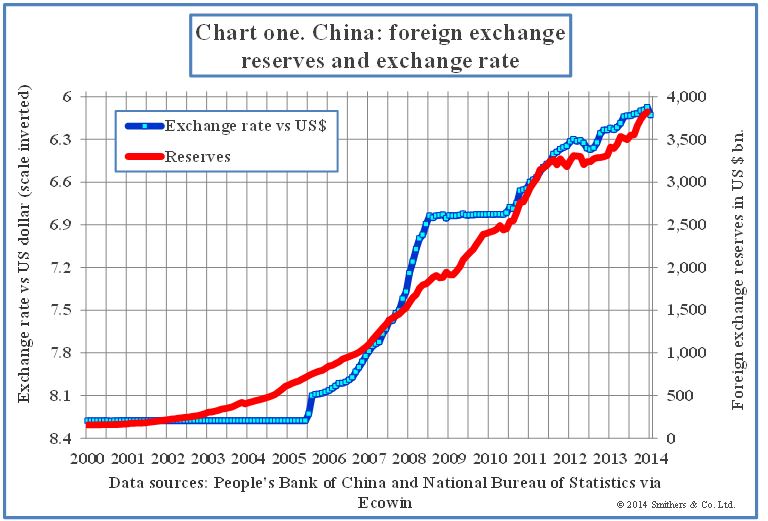
The Chinese government decided some years ago to keep its exchange rate undervalued by buying foreign currency and building up its foreign exchange reserves. The result has been dramatic. Reserves have risen by $3tn over the past seven years. This has occurred despite a strong rise in the exchange rate, as I show in chart one.
The rise in the reserves required China to buy dollars in exchange for domestic currency (renminbi) and, if no steps had been taken to “immunise” this, there would have been a dramatic rise in domestic liquidity with the probable result that inflation would have raced ahead. Immunisation can be achieved by funding a rise in exchange reserves through issuing long-term debt, but China’s bond market does not seem to have been sufficiently developed for this to have been done. Instead, the immunisation was achieved by requiring commercial banks to increase their deposits with the central bank.
This policy had its drawbacks. Lending to the central bank was less profitable than lending to commercial customers; as it reduced their profits, banks paid low interest rates on their deposits. This encouraged savers to put their money into an unregulated world of parallel financial institutions.
Having caused the rapid expansion of an unregulated parallel banking system, China now has to prevent it blowing up. This is likely to prove tricky as the rates of interest being paid seem way too high to be economic. As reported by the FT’sJames Kynge, the local view is that “you can get around 10 to 12 per cent by lending to a trust or around 20 per cent by putting it with an underground bank”.
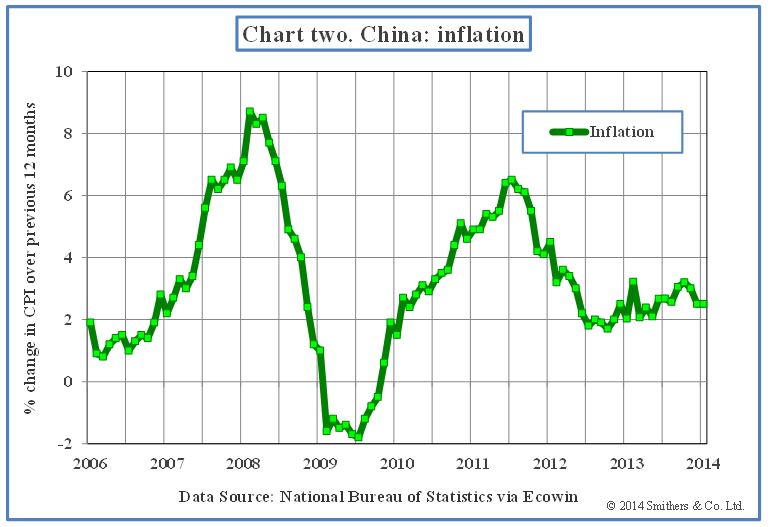
China grows more rapidly than the US and, according to an economic theory called the Balassa-Samuelson effect, it should therefore have a steadily rising real exchange rate and this, as chart one shows, it has had. The equilibrium real “risk-free” interest rate in China is thus lower than that in the US. As the US nominal rate is more or less zero, this can only be achieved if China has a more rapid rate of inflation than the US. At the moment prices are rising at about 2 per cent a year in China (chart two) which is almost exactly the same as in the US.
At the moment, as Mr Kynge quotes a shadow banker, “it is easy to borrow abroad at around 1 per cent annual interest … and bring it into the mainland”. Even with exchange controls, borrowing abroad can be achieved by over-invoicing exports. So foreign money comes in and either pushes up the exchange rate or the exchange reserves. If the former, it increases the profits on the carry trade; if the latter, it increases domestic liquidity and thwarts attempts by the People’s Bank of China to rein in excessive debt expansion.
The interest rates being paid in the parallel banking market are so far above the “risk-free” rate that they would seem to be very risky and should therefore result in lots of bankruptcies. If this happened, it would make the carry trade much less profitable, but might well set off a financial crisis.
Higher inflation in China would allow real interest rates to fall, and thus make the interest rates being paid in the parallel market less uncertain. This would be risky, as it is difficult to control a rise in inflation. However, I find it difficult to see what other solution is available.
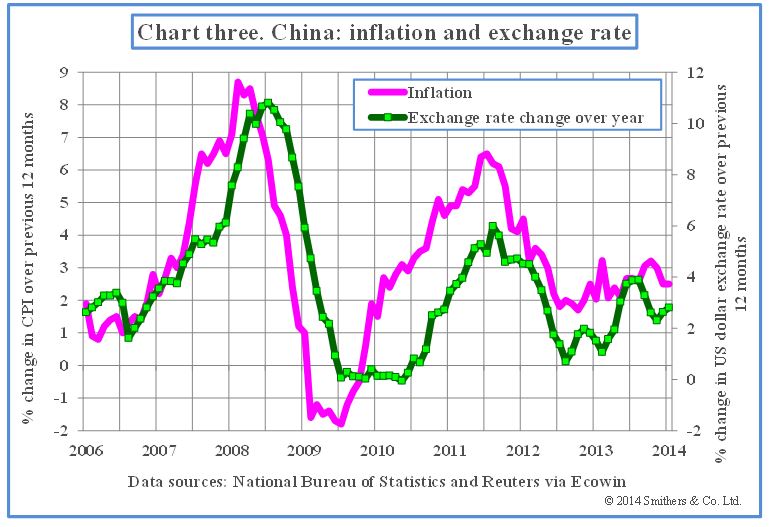
In the past, as chart three shows, China appears to have used its exchange rate to dampen inflation. A lower and probably more volatile exchange rate would now seem to be sensible.

Andrew Smithers


Fonte: FT

segunda-feira, 31 de março de 2014