sexta-feira, 18 de setembro de 2015
The unbearable lightness of leaving Greece
Nostalgia. It is a word formed from Greek roots, and that is fitting, since Greece is not a country you easily leave. Nostos, the journey of return to the homeland. Algos, a pain that afflicts the mind. Put them together: a wistful longing to go back. For a Greek far from home, no word sounds more bittersweet.
Yet here we are, thousands of twentysomethings living abroad while so many back home wish they had our luck. Is leaving perhaps not so hard after all?
My country has lately been defined by different words altogether. Austerity, the consequence of a crisis that began more than five years ago. The reviled Troika of international lenders, who enforce this harsh regime. Unemployment, austerity’s consequence in turn, and a fate that now befalls one in four Greeks. Elections— taking place on Sunday for the fifth time in six years.
It is sometimes a relief to be one of the 200,000 young Greeks living abroad who do not have to experience every day the demise of our country and its people.
That way you do not have to see your local bookshop close down and the tax authority bar the staff from giving away the remaining stock. You do not have to be there when the door slams shut on a toy shop that was the Aladdin’s cave of your childhood, or watch your parents console their friend who was the owner. When homeless people appear on the street corner, when members of your own family search frantically for a job — you do not have to witness these things either. When people ask each other how they will avoid falling back on elderly parents for money, they ask someone other than you.
It is a relief, too, to have a university life undisturbed by political upheaval: free of protests and elections that delay exams or curtail lectures, unmarred by the sudden shortages of cash that create shortages of everything else, leading to classrooms without heat or sometimes even chairs.
It is a relief, however, that is tinged with loss.
One thing that Greeks lose by living abroad is the right to vote — expatriates in the UK could not vote in the July referendum unless they returned home, and the same goes for this weekend’s parliamentary elections.
And some say we also lose the right to a point of view. I was at home in the week before the July referendum. The debate was everywhere — vote yes or vote no. But joining in was awkward. You don’t live here, people would say. This doesn’t concern you. Don’t be so passionate about it.
It is true that even mentioning what we lose seems ungrateful when you consider what we have gained by choosing to leave.
High quality global journalism requires investment. Please share this article with others using the link below, do not cut & paste the article. See our Ts&Cs and Copyright Policy for more detail. Email ftsales.support@ft.com to buy additional rights. http://www.ft.com/cms/s/0/a14fa20c-5c81-11e5-9846-de406ccb37f2.html#ixzz3m9M0FuDq
With close to half of young adults currently unemployed, Greece is not a land of opportunity. School friends of mine moved to Athens in search of an entry level job in architecture, only to go back home after finding they could not find work that paid, or paid enough. Graduates of law, or of the polytechnic school, were obliged to go back to their rural roots as soon as they finished their degree; the only jobs they could find were with their family business.
Then again, perhaps “choice” is not the right word to describe the act of leaving Greece.
One of my closest university friends is from Japan. She considered staying in London, but decided to return to Tokyo; at home, she said, there would be more opportunities. For me, it was a disorienting decision.
It is not that I have never thought of returning home. Two weeks before I left Greece for my fourth year in London (and my first after finishing my degree) I began to wonder. Could I stay, and follow a path that would contribute to my country’s recovery without throwing my own future away?
Friends who still live there did their best to discourage me. Trying to become a political journalist in my home town would be futile; most of the newspapers in Thessaloniki shut down long ago. I contacted some media outfits in Athens, where my prospects seemed better. But getting paid was out of the question.
Choosing entails having the freedom to decide between options that are all at least decent. And for a young person in Greece, such choices are what you gain only when you leave.
In other countries it is different. You aim high, you do your best, and you know that while failure is a possibility, so is success. You are not thwarted before you even start; you actually experience yourself working towards your goals.
But for a Greek, it makes no sense to go home — as my Japanese friend did — so you can choose your own course.
The biggest brain drain in Europe is a harsh thing to have to watch. Who will remain if all of us leave in search of a better future? To that I have no answer.
But it is scarcely more comfortable to be joining the exodus. Staying would be the bigger sacrifice. But even in avoiding that loss, something precious must be given up.
For there is more to Greece than the financial crisis, political instability and a worsening migration problem. Greece is fresh fish and homemade olive oil, basil, thyme and chamomile. It is the sea, the sun, the sunset; music, family, friends.
It is home. And no matter where you end up, it will always be where you began.
Iliana Magra, a politics graduate who grew up in Greece, has lived in London since 2012


quinta-feira, 17 de setembro de 2015
Guessing games have added to volatility
The Federal Reserve’s decision to keep interest rates on hold brings some much-needed release to the pent-up uncertainty in financial markets. It is also the right choice: the US economy is still far from building up sustained growth momentum, and inflationary pressures are more remote than in June. But if the past few months have shown anything, it is that the uncertainty around the Fed’s decision matters in its own right, beyond the exact rate the policymakers plump for.
The guessing games around what the Fed’s open market committee, and chair Janet Yellen in particular, would do, have contributed to volatility and amplified other disturbances in financial markets, above all the Chinese stock market collapse and exchange rate policy changes. The FOMC’s big task now, as it continues to calibrate the optimal timing for an eventual rate rise, is to manage that nervous anticipation better than it did in the months leading up to Thursday’s decision.
The Fed’s opaqueness — market observers saw the decision as a toss-up until shortly before this week’s meeting — was in some measure unavoidable. Ms Yellen and her committee have emphasised that they will be guided by evolving data. And the data have not necessarily evolved to the advantage of clarity. With the world as uncertain as it is, it was natural that markets found it hard to predict what Ms Yellen might do — she may well not have known herself until it was time to decide.
But avoidable errors made the uncertainty worse. In earlier remarks, Ms Yellen had unwisely tied herself to the calendar by suggesting a rate rise “later this year”. That, of course, was always hostage to fortune: you cannot be both fully data-dependent and time-dependent, because data may not move to the timing you expect. When that happens — as it has — something has to give, and your credibility suffers as a result. That is why when the Bank of England formally introduced guidance to markets as a policy tool, it explicitly forswore what in the jargon is called “time-contingent guidance”, opting for “state-contingent” guidance instead.
Another problem has been that, despite Ms Yellen’s deep appreciation of how the Fed’s communication is itself a policy tool, markets have not understood well the data conditions that would make the FOMC make one or another choice. The “reaction function”, as the term of art goes, is unclear. With the September 17 decision out of the way, Ms Yellen and her colleagues have an opportunity to ameliorate this problem.
The decision itself helps clear up some of the uncertainty. We can now put more weight on international developments and market inflation forecasts in guessing how the Fed will act. Had it raised the rate, we would instead have shifted our attention more to domestic factors and the low unemployment rate. The update of the FOMC’s own forecasts corroborates a more dovish reaction function than we could previously have attributed to the Fed with confidence. So, too, does Ms Yellen’s press conference, in which she affirmed that the 2 per cent inflation rate is a target (read: average target), not a ceiling.
All this is doubly good: because it shows a Fed more likely to do the right thing — but also just because it makes it clearer how the Fed will behave.
Ms Yellen and her colleagues must now reinforce this improvement. FOMC members and Ms Yellen herself could usefully spend the next few months outlining their personal reaction functions better, pinning down in more detail how the data would have to change for them to vote for a rate rise — or indeed for a cut into negative territory, as one FOMC member now believes appropriate.
In uncertain times, state-contingent policy guidance remains the right approach for central banks. But how and on what states policy will depend is something interest rate setters should explain in more detail and on an ongoing basis. That should help both them and us manage the unavoidable uncertainty better.
Martin Sandbu
Fonte: FT
quarta-feira, 16 de setembro de 2015
Fundamentalistas: marxistas e keynesianos.....
Há algo de bastante peculiar na visão de pluralismo do marxista fundamentalista da terra das jabuticabas exóticas : ser plural implica em concordar com todas as posições que eles defendem, mesmo aquelas que alguem minimamente informado sobre o estado atual de pesquisas no marxismo, sabe serem coisas do passado. É um marxismo iletrado, que desconhece a pesquisa recente do próprio campo de pesquisa a qual pertencem, ou afirmam pertencer. Leva-los a serio é perda de tempo, mas não é nada fácil ficar em silêncio diante de tamanha demonstração de soberba. Mas, aprendi, em Oxford, que a melhor resposta aos iletrados é simplesmente ignora-los. Conceder-lhes atenção ou responder aos comentários seria rebaixar ao mesmo nível. O silêncio, nestas horas, é a melhor resposta.
Alias, eles, infelizmente, não são os únicos que precisam voltar a frequentar, urgentemente, uma boa biblioteca. Conheço alguns desenvolvimentistas que são bons economistas, mas a posição de vários membros dessa corrente em relação ao ajuste fiscal é simplesmente incompreensivel. A leitura deles de Keynes é empobrecedora, e lembra muito a leitura dos marxistas fundamentalistas de Marx. Formam uma dupla terrivel, que passaram longe dos livros basicos de macroeconomia e microeconomia de qualquer programa de mestrado em economia. Pra não mencionar os de doutorado. Papers então, nem pensar. O conhecimento que tem do estado atual da macro mainstream é de chorar. O curioso é que ambos desconhecem o significado da palavra modestia. Fazer o que, diria o meu pai.
terça-feira, 15 de setembro de 2015
A new Chinese export — recession risk
Is a global economic recession likely? If so, what might trigger it? Willem Buiter, Citi’s chief economist and the Financial Times’ erstwhile Maverecon blogger, answers these questions: “Yes” and “China”. His case is plausible. This does not mean we must expect a recession. But people should see such a scenario as plausible.
Mr Buiter does not expect world output to decline. The notion here is a “growth recession”, a period of growth well below the potential rate of about 3 per cent. One might imagine 2 per cent or less. Mr Buiter estimates the likelihood of such an outcome at 40 per cent.
His scenario would start with China. Like many others, he believes China’s growth is overstated by official statistics and may be as low as 4 per cent. This is plausible, if not universally accepted.
It might become even worse. First, an investment share of 46 per cent of gross domestic product would be excessive in an economy growing 7 per cent, let alone one growing at 4 per cent. Second, a huge expansion of debt, often of doubtful quality, has accompanied this excessive investment. Yet merely sustaining investment at these levels would require far more borrowing. Finally, central government, alone possessed of a strong balance sheet, might be reluctant to offset a slowdown in investment, while the shares of households in national income and consumption in GDP are too low to do so.
Suppose, then, that investment shrank drastically as demand and balance-sheet constraints bit. What might be the effects on the world economy?
One channel would be a decline in imports of capital goods. Since about a third of global investment (at market prices) occurs inside China, the impact could be large. Japan, South Korea and Germany would be adversely affected.
A more important channel is commodity trade. Commodity prices have fallen, but are still far from low by historical standards (see chart). Even with prices where they are, commodity exporters are suffering. Among them are countries like Australia, Brazil, Canada, the Gulf States, Kazakhstan, Russia and Venezuela. Meanwhile, net commodity importers, such as India and most European countries, are gaining.
Shocks to trade interact with finance. Many adversely affected companies are highly indebted. The resulting financial stresses force cutbacks in borrowing and spending upon them, directly weakening economies. Changes in financial conditions exacerbate such pressures. Among the most important are movements in interest and exchange rates and shifts in the perceived soundness of borrowers, including sovereigns. Changes in capital flows and risk premia and shifts in the policies of important central banks exacerbate the stresses. At present, the most important shift would be a decision by the US Federal Reserve to raise interest rates.
As Warren Buffett said: “You only find out who is swimming naked when the tide goes out.” According to the Bank of International Settlements, credit to non-bank borrowers outside the US totalled $9.6tn at the end of March. A strong dollar makes any currency mismatches costly. These may start on the balance sheets of non-financial corporations. But the impact will be transmitted via their losses to banks and governments. Thus, reversal of “carry trades”, funded by cheap borrowing, might wreak havoc.
A visible shift is a decline in foreign exchange reserves, driven by deteriorating terms of trade, capital flight and withdrawal of previous capital inflows. This might cause “quantitative tightening”, as central banks sell holdings of longer-dated safe bonds. This is one of the ways that these shocks might be transmitted to the high-income countries, including even the US. But this also depends on what the holders of the withdrawn funds do with it and on the policies of affected central banks.
What we might see, then, is a series of real and financial linkages: declining investment and output in China; weaknesses in economies dependent on that country’s purchases or on prices set by its buying; and reversals of carry trades and shifts in exchange rates and risk premia that stress balance sheets.
How might policymakers respond? China will surely let its currency fall rather than continue to lose reserves, not least because usable reserves are smaller than headline numbers, which include infrastructure investments in Africa and elsewhere that cannot quickly be sold. The policy space of other emerging economies is greater than in the past, but not unlimited. They will be forced to adjust to these shocks rather than resist them.
Meanwhile, the policy choices of high-income countries are restricted: politics has almost universally ruled out fiscal expansion; the intervention rates of central banks are near zero; and, in many high-income economies, private leverage is still quite high. If the slowdown were modest, nothing much might be done. The best response to a big slowdown might be “helicopter money”, created by the central bank to stimulate spending. But its use seems quite unlikely. The conventional rules.
In brief, a global growth-recession scenario “made in China” is perfectly plausible. If it were to happen, a decision by the Fed to tighten now would come to look downright foolish. We are not talking about the sort of disaster that accompanies a global financial crisis. But the world economy will remain vulnerable to adversity until China has completed its transition to a more balanced pattern of growth, and the high-income economies have recovered from their crises. That is still far away.
Martin Wolf
Fonte: FT
segunda-feira, 14 de setembro de 2015
Gideon Rachman: The crises that threaten to unravel the EU
There is a comforting cliché in Brussels that the EU needs crises in order to progress. But the current cocktail of problems facing Europe — refugees, the euro and the danger that Britain might leave the union — look far more likely to overwhelm the EU than to strengthen it.
For the first time in decades, some of the fundamental achievements and tenets of the EU are under threat. These include the single currency, open borders, free movement of labour and the notion that membership is forever.
Rather than rising to these challenges, the EU is creaking under the strain. Its 28 members are arguing bitterly and seem incapable of framing effective responses to their common problems.
These arguments are also taking place against an ominous backdrop. Large parts of the EU remain sunk in a semi-depression with high unemployment and unsustainable public finances. The problems of an imploding Middle East are crowding in on Europe, in the form of hundreds of thousands of refugees. And the political fringes are on the rise — with the latest evidence being the election of a far-left eurosceptic candidate to lead Britain’s Labour party.
With a sense of crisis mounting and the EU unable to respond, countries will be increasingly inclined to act unilaterally or even — in the case of Britain — leave the bloc altogether.
The refugee crisis is already threatening cherished ideas about open borders. In the past couple of days, Germany has reimposed frontier controls with Austria — which, in turn, has imposed controls at its border with Hungary, which itself is working feverishly to complete a barbed-wire fence to protect its frontier with non-EU Serbia. Controls have been tightened on the French-Italian borders, while migrants camp miserably in Calais, hoping to cross to England.
If the EU somehow gets a grip on the migrant crisis, these measures might be no more than temporary expedients. But if the pressure of would-be refugees heading for Europe remains intense, then temporary measures could harden into permanent controls.
Question marks over open borders will easily shade into wider issues about access to welfare systems and labour markets. That is because EU countries are realising that — in a border-free single market — a unilateral change of asylum rules by Germany has implications for the immigration policies of all member states. Once migrants get citizenship in one EU country, they have the right to move to any other, to work there and to claim benefits. But if free movement of people and labour come into question, so does the EU’s single market — its central achievement.The refugee issue has, for the moment, overshadowed the euro. But the problems of the single currency have not gone away. On the contrary, Greece’s decision this summer to knuckle under and accept yet another austerity package has made the eurozone look increasingly like a trap.
Even Greece, which is profoundly unhappy with life in the eurozone, cannot risk leaving for fear of provoking a financial and economic crisis. Creditor countries such as Germany and the Netherlands are not much happier, as they fear they are being dragged into a system of permanent fiscal transfers towards the nations of southern Europe. Meanwhile, efforts to make the euro work better, by pressing ahead with a banking union, are stuck in Brussels. This does not look like a sustainable situation and the risk of euro break-up will surely return.
The refugee and euro crises bear on whether Britain will vote to stay in the EU, when it holds a referendum in 2016 or 2017. Until recently, the opinion polls looked promising for the pro-EU camp. But the migrant crisis plays directly into the most potent issue deployed by those campaigning for Britain to leave — which is that membership of the EU means that the UK cannot control immigration. More broadly, the British are less likely to stay inside an organisation that seems to be failing. If they vote to leave, the sense of crisis within the EU would then mount — raising the possibility of further defections.
A partial unravelling and marginalisation of the EU still looks more likely than a full-scale collapse. But even if an organisation called the European Union continues to exist — running buildings and paying salaries — it risks becoming increasingly irrelevantThe trouble is that the EU’s complex and unwieldy decision-making processes make it extremely hard to respond quickly and coherently to a crisis — as the migrant issue illustrates.The best way to avoid these sorry fates would be for the bloc to demonstrate its relevance and effectiveness — by showing EU citizens that collective action and co-operation are the only ways of dealing with issues like the migrant crisis.
For people of my generation, one of the central political themes of the past 40 years has been the steady advance of the European project. It is hard (and alarming) to imagine all that going into reverse. But Europe’s turbulent history is littered with examples of empires, monarchies and alliances that rose to greatness and then collapsed. The organisation that the EU sometimes reminds me of at the moment is the League of Nations — a high-minded body, committed to international co-operation and the rule of law — that was eventually swept aside by international events that it could not cope with.
Gideon Rachman
Fonte: FT
quinta-feira, 10 de setembro de 2015
Recado duro mas necessário da S&P...
A S&P rebaixou o rating dos USA por uma questão politica: o comportamento dos republicanos estava colocando em risco a recuperação da economia americana. No Brasil acho que a antecipação do rebaixamento, esperado para o próximo ano, também tem um forte componente político: recado a Presidente Dilma e ao Parlamento brasileiro. Por isto é importante mudar o gabinete e colocar pessoas mais habilidosas do lugar do Mercadante e do Jose Eduardo pra desanuviar o ambiente político .Também é importante deixar claro o apoio da Presidente ao Ministro Levy. Nada. Absolutamente nada, justifica a manutenção em seu gabinete de dois Ministros-economistas que compartilham a mesma visão de política econômica da Presidente Dilma. A gestão seria mais eficiente e os sinais mais claros, se a dualidade ficasse limitada a Dilma e ao Ministro da Fazenda. Um técnico no Planejamento, desprovido da pretensão de ocupar o cargo do Levy, seria a melhor opção. É pouco provável que isto ocorra, já que a atual gestão parece ter um inacreditável desejo de cometer suicidio.
A perda do grau de investimento das 2 irmãs da S&P, se ocorrer não será uma consequencia do ajuste. Muito pelo contrário. Ë a ausencia de un ajuste fiscal crível que é o problema. E o ambiente político e totalmente desfavor. A agencia enviou um recado duro, mas necessário, ao governo e ao parlamento: sem ajuste fiscal não tem conversa. Nos USA o recado funcionou e ajudou a enquadrar os republicanos e construir pontes com o Governo Obama. Espero que o mesmo ocorra na terra das jabuticabas.
A perda do grau de investimento das 2 irmãs da S&P, se ocorrer não será uma consequencia do ajuste. Muito pelo contrário. Ë a ausencia de un ajuste fiscal crível que é o problema. E o ambiente político e totalmente desfavor. A agencia enviou um recado duro, mas necessário, ao governo e ao parlamento: sem ajuste fiscal não tem conversa. Nos USA o recado funcionou e ajudou a enquadrar os republicanos e construir pontes com o Governo Obama. Espero que o mesmo ocorra na terra das jabuticabas.
Patrick Jenkins: Make advisers pay when deals go wrong
Another week, another slew of megadeals. With tens of billions of dollars of mergers and acquisitions now being announced on a daily basis, 2015 is shaping up to be a near-record year for M&A.
Deals make everyone feel better, at least in the short term. Directionless chief executives suddenly look purposeful. M&A bankers delight in the gravy train of bonuses. And shareholders feel upbeat, as share prices rise. (It is a sure sign of an exuberant market when shares in both acquirer and target rise on the announcement of a deal, as they have tended to recently.)
Echoing previous booms, deals are being done at generous, sometimes ridiculous, valuations: exuberant chief executives are desperately seeking expansion in a low-growth global economy. Dealogic says deal premiums are running at their highest level for three years. Acquirers have been encouraged by inflated equity valuations, which can make stock deals attractive, and low interest rates, which ease cash financing. Bullish bankers have shrugged off recent market volatility, insisting that the dealmaking boom will carry on regardless.
History and common sense suggest they are wrong. Nervousness about the slowing Chinese economy, and overvalued markets, will continue to bear down on asset valuations. Meanwhile, interest rates in the US and UK are likely to start rising in the months ahead, potentially exacerbating market nervousness, especially in dollar-funded emerging markets. Interest rate rises are likely to be slow and steady. But clearly the days of ultra-cheap takeover finance are numbered.
The question, then, is not whether the M&A bubble will deflate, but how quickly. That in turn will clarify how many of the deals done at the peak look absurdly overpriced once testosterone levels have abated.
Two of the most recent takeover booms preceded the emerging markets bust of 1997 and the dotcom crash of 2001. Today the most bearish investors see a repeat looming, given the headiness of valuations in many markets, particularly technology stocks.
There is, of course, a so-what argument. Capitalism operates in cycles and downturns can be painful. Excitable companies and their investors may lose out. Hard luck.
But for at least eight years, free markets have been far from genuinely free. The M&A boom, like so many of today’s bubbles, has been inflated in part by the policy response to the financial crisis — not just directly, via cheap money, but through the personal financial incentives that are at play.
The adviser at an investment bank with a big lending operation may be tempted to drive through an M&A transaction with an eye on the loan fees — and correlated bonus accruals — rather than the merits of the deal itself.
Less observed has been the market distortion in M&A created by the tougher rules imposed on investment banks in the aftermath of the financial crisis. As the Financial Times reported this week, the regulatory crackdown — relating to capital, compliance and pay — has encouraged many advisers to leave their bank employers and set up alternative advisory boutiques.
These lightly regulated entities have far more of an incentive to push deals, regardless of merit, because individuals can end up with multimillion dollar windfalls from single deals.
Patrick Jenkins
Fonte: FT
Lawrence Summers: Why the Fed must stand still on rates
Two weeks ago, I argued that a Federal Reserve decision to raise rates in September would be a serious mistake. As I wrote my column, the market was assigning a 50 per cent chance to a rate hike. The current chance is 34 per cent. Having followed the debate among economists and Fed governors and bank presidents I believe the case against a rate increase has become somewhat more compelling even than it looked two weeks ago.
Five points are salient.
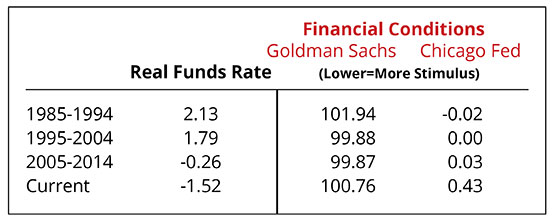
First, markets have already done the work of tightening. The US stock market is worth $700bn less than it was two weeks ago and credit spreads have widened noticeably. Financial conditions as measured by Goldman Sachs or the Chicago Fed index have tightened in the last two weeks by the impact equivalent of more than a 25 basis point tightening. So even if resisting inflation required a 25bp tightening as of two weeks ago, this is no longer the case.
The figure below makes a crucial point. It shows that even though the federal funds rate is very low (negative 1.5 per cent after adjusting for inflation), financial conditions are helping the economy less than in previous years when interest rates were much higher.
 Second, the data flow suggests a slowing in the US and global economies and reduced inflationary pressures. Employment growth appears to have slowed, commodity prices have fallen further, and the general data flow has been on the soft side. Comprehensive measures of data surprises, such as the Bloomberg Economic Surprise Index, bear out this impression and the Atlanta Fed’s GDP Now model is currently predicting only 1.5 per cent growth in Q3.
Third, the case for concern about inflation breaking out is very weak. Market-based expectations suggest that inflation over the next decade on the Fed’s preferred core PCE basis is near record lows and well below 2 per cent. The observation that five-year inflation, five years from now is expected to be below target calls into question arguments that current low inflation is somehow transitory.
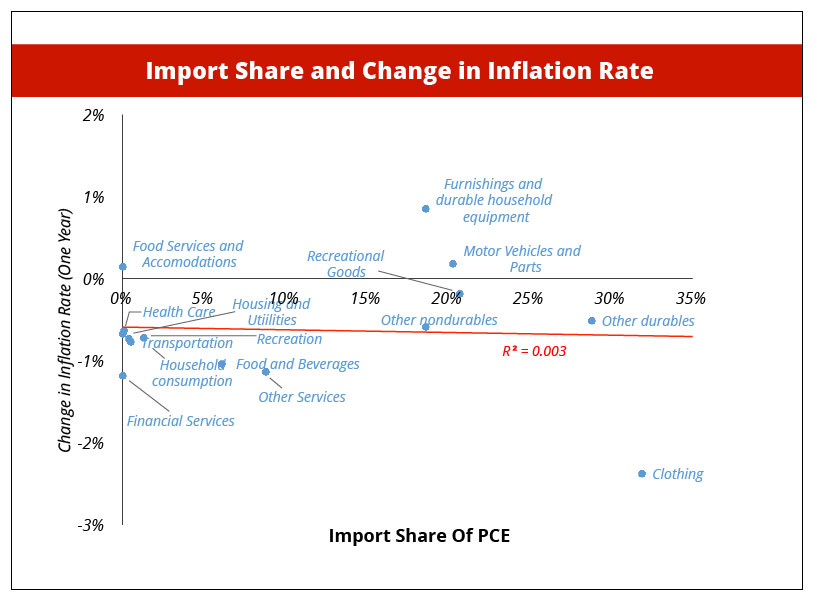
The analysis presented by Fed vice-chairman Stanley Fischer asserting to the contrary relies on assumptions about exchange rates and inflation. When actual empirical estimates are used his conclusions are substantially weakened. Indeed, as the figure below shows, there is no correlation of late between deceleration in inflation and import share looking across PCE components.
 Also, as regards inflation, it bears emphasis that (i) we have some room for inflation acceleration; (ii) prices are now fully 2 per cent below a 2 per cent inflation path taking off from 2010; (iii) the Phillips curve is so unstable that it provides little basis for predicting inflation acceleration. To take just two examples — first, unemployment among college graduates is 2.5 per cent yet there is no evidence that their wages are accelerating. And unemployment in Nebraska has been below 4 per cent for the last three years and growth in average hourly earnings has been basically constant at the national average level.
Fourth, arguments of the “one and done” variety or arguments that the Fed can safely raise rates by 25bp as long as it’s clear that there is no commitment to a series of hikes are specious. If, as some suggest, a 25bp increase won’t affect the economy much at all, what is the case for an increase? And when the same people argue that 25bp will have little impact and that it is vital to get off the zero rate floor, my head spins a bit.
In a highly uncertain world, the Fed cannot be both data dependent and predictable with respect to its future actions. Much better that it stick with data dependence than that it put its credibility at risk by seeking to mitigate a current rash action by trying to reassure with respect to future steps.
I understand the argument that zero rates are a sign of pathology and the economy is no longer diseased so policymakers have to increase rates. The problem is that the case for hitting the brakes in an economy with sub-target inflation, employment and output is not there; regardless of whether the brakes are to going to be pressed hard or softly, singly or multiple times.
From the Vietnam war to the euro crisis, from the Iraq war to the lessons of the Depression we surely should learn that policymakers who elevate credibility over responding to clear realities make grave errors. The best way the Fed can maintain and enhance its credibility is to support a fully employed American economy achieving its inflation target with stable financial conditions. The greatest damage it could do to its credibility would be to embrace central banking shibboleth disconnected from current economic reality.
Fifth, I believe that conventional wisdom substantially underestimates the risks in the current moment. It bears emphasis that not a single post-war recession was predicted a year in advance by the Fed, the Federal government, the IMF or a consensus of forecasters. Most were not recognised until long after they started. And if history teaches anything it is that financial interconnections are pervasive and not apparent until it’s too late. Russia’s 1998 default, problems in subprime lending and the Asian financial crisis were all moments when financial dislocations had far more pervasive effects than was generally expected.
We know that the world’s largest economy, China, is in its most uncertain state since it began economic reform in 1979 and may well be experiencing a larger volume of capital flight than any economy in history. We know that the central banks of Japan and Europe are likely to have to double down in the months ahead on already extraordinary quantitative easing. We know that American households, companies and markets are processing what appears to a kind of “reverse 1990s” moment of sharply decelerating productivity growth. We know that liquidity conditions in markets have worsened and there is at least some reason to believe that “positive feedback” trading strategies where investors sell when prices go down may well have become increasingly important. We know the current US recovery is in its seventh year and that confidence in public institutions is at a low ebb.
More likely than not, these fears are overblown and 2015 and 2016 will not go down in financial history. If so, and the Fed does not act, inflation will start to accelerate, volatility will subside and policy can step in. Regret may come in the form of inflation a few tens of basis points too high or a bit of euphoric relief in markets. If on the other hand, some portion of these fears are warranted and the Fed tips towards tightening, it risks catastrophic error.
Now is the time for the Fed to do what is often hardest for policymakers. Stand still.
Lawrence Summers
Fonte: FT
sexta-feira, 4 de setembro de 2015
It’s official: money can buy you happiness
Forget what your parents, your self-help guides or your religion may have told you: money can buy you happiness.
That, at least, is the conclusion from the number crunchers at the UK’s Office for National Statistics, who have combined data from surveys on household wealth and personal wellbeing.
“Life satisfaction, sense of worth and happiness are higher, and anxiety less, as the level of household wealth increases,” the ONS said in a paper released on Friday.
Indeed, one very specific type of money has the strongest relationship with wellbeing: net financial wealth, which could be stocks and shares, savings in the banks or money under the mattress.
However, Generation Rent — young people struggling to get on the housing ladder — need not despair entirely. The ONS found that increasing property or personal pension wealth did not result in a measurable increase in wellbeing. Levels of household income — rather than assets already owned — were also far less strongly related.
Surprisingly, although physical assets such as antiques, yachts, swish cars or stamp collections might induce smugness, the ONS found they had no relation to levels of personal wellbeing, which may or may not disprove the theory that it is nicer to cry in a Ferrari than on a park bench.
The ONS asked individuals to rate their own wellbeing on a scale of 0 to 10, on questions such as how satisfied they were with life and were the things they did worthwhile? These responses were then crunched alongside household wealth and income, with the statistical model controlling for variables such as gender or ethnicity, to see what impact wealth or income had on an otherwise alike individual.
The ONS is confident the relationships it describes are statistically significant. For net financial wealth, for example, those in the bottom 20 per cent scored themselves on average 0.4 points lower than those in the middle 20 per cent.
The report is the latest entry into the debate about whether it is absolute or relative income and wealth that matter when it comes to improving wellbeing.
For instance, in influential papers, the economists Betsey Stevenson and Justin Wolfers tried to find evidence to support the idea that what matters for wellbeing is how you compare with those around you — in other words, keeping up with the Joneses. They failed.

After looking at multiple countries and numerous definitions of wellbeing and basic needs, they concluded: “If there is a satiation point [at which income and wellbeing are no longer related], we are yet to reach it”.
More importantly for policymakers, perhaps, they found that countries that enjoyed faster economic growth, on average also experienced greater growth in wellbeing.
In 2006, David Cameron, then opposition leader, urged statisticians to focus more alternative measures of the national quality of life. “Wellbeing cannot be measured by money or traded in markets,” he said.
Yet the new statistics, which resulted from his policy drive, suggest perhaps you can have a good go.
Diane Coyle, founder of Enlightenment Economics, is one economist who thinks statistics should be focused on more tangible outcomes.
“I don’t think we should be measuring happiness at all. It is not a ‘policy useful’ measure. The government doesn’t have levers that easily affect happiness, and should concentrate on the things that government can do,” she said, pointing to employment or spending on mental health.
In previous work by the ONS, good health, type of employment and personal relationships have proved to have the strongest links to high levels of self-reported wellbeing. At least the first two are something the government can do something about.
And if you don’t believe the ONS, you might agree with Ronald Reagan when he said: “Money can’t buy happiness, but it will certainly get you a better class of memories.”
Emily Cadman
Fonte: FT
quinta-feira, 3 de setembro de 2015
Alexis through the looking-glass world of Greek politics
Ainda é cedo pra fazer previsões sobre o resultado das eleições gregas. Tsipras ainda é muito popular, mas o seu partido nem tanto. Um governo de união nacional parece ser a melhor opção, mas isto está longe de ser uma tarefa fácil. A pressão europeia( nos bastidores) será fundamental pra a formação de um governo estável e em condições de implementar as reformas necessárias à retomada do crescimento na Grecia. Emoções à vista.
In the looking-glass world of Greek debt politics, everything changes from one year to the next and everything stays the same. Consider the snap election that takes place on September 20, hard on the heels of the country’s third financial rescue in five years. Latest opinion polls indicate that Alexis Tsipras, the leader of the leftwing Syriza party and former prime minister who triggered the election in a bid to strengthen his grip on power, is at risk of defeat. Yet will it matter? Whatever the result, the ravaged economy will remain suffocated by the same fog of illusions that enshrouds relations with its creditors.
Everything changed when Syriza took office in January on a wave of support for overturning the orthodoxies of eurozone financial and economic policy. After months of helter-skelter rule, and after breaking with his party’s dogmatic ultra-leftist faction, Mr Tsipras still finds it hard to suppress his distaste for these orthodoxies.
Yet everything is the same because Syriza signed up in July for a €86bn bailout from its European creditors. The government accepted a trade-off between financial aid and internationally supervised domestic reform — just as its centre-left, technocratic and centre-right predecessors did between 2010 and 2014. Mr Tsipras even relied on the parliamentary support of his centre-left and centre-right adversaries to legitimise the bailout. Hard-pressed Greeks can be excused for asking why it is necessary to elect a new parliament for the fifth time since October 2009, and what practical difference it will make to their lives if they vote for Syriza or any of its mainstream rivals.
Everything is different because the third bailout has removed the threat, dangled in July by Germany, that Greece might be suspended from the eurozone — a possible prelude to Grexit, or permanent exit. The bailout is intended to last until 2018, eliminating for three years the risk that Greece might default on repayments to its European lenders and the International Monetary Fund.
Yet everything is the same because, in the make-believe world inhabited by Greece and its European creditors, everyone pretends the next government in Athens — whatever its political complexion — and the Greek public administration at all levels will carry out reforms as required. This lets the creditors pretend to their voters, as they have done since the first, €110bn, bailout of May 2010, that Greece will repay its loans in full. It helps Greek politicians defend themselves against the accusation they have hoodwinked other European governments into supplying a constant flow of funds in return for nothing.
Make-believe politics reached its apogee two weeks ago when Martin Selmayr, chief aide to Jean-Claude Juncker, European Commission president, tweeted that the snap election was a good move because it might broaden domestic support for the new rescue programme. Actually, the campaign points to deep political uncertainty and perhaps even yet another election.
Support for Syriza is draining faster than euros from Greek bank accounts before the introduction in June of capital controls. Any hope Mr Tsipras had of winning an outright parliamentary majority has vanished. According to an opinion poll on Wednesday, Syriza has even fallen slightly behind the centre-right opposition New Democracy party.
Greece faces one of two prospects. The first is a Syriza-led government, in which the dominant party must work with coalition partners it dislikes to implement a foreign-imposed reform programme it dislikes even more. The second is a New Democracy-led government, made up of parties that were largely responsible for the mess and have shown little capacity to clean it up.
One way or another, the uncertainty created by the election will stall reforms, delay debt relief, threaten recovery and resurrect the spectre of Grexit. If this sounds like a record you have heard before, you are right.
Tony Barber
Fonte: FT
quarta-feira, 2 de setembro de 2015
IMF warns against rate rises by leading economies
The IMF urged the world’s leading central banks on Thursday to refrain from raising interest rates in a bid to boost spending in the global economy when risks to growth were mounting.
The fund’s message to the most powerful central bankers and finance ministers travelling to Ankara for a Group of 20 meeting at the weekend is that the performance of the majority of economies is again falling short of expectations at the beginning of the year.
The IMF is calling for action to prevent growth rates from faltering and to raise the medium term performance of the world’s largest economies from the current “moderate” level.
The Federal Reserve, which is considering raising US interest rates this month, was not alone in the line of the fund’s fire. In an agenda-setting note to G20 finance ministers and central bank governors, the IMF said that an expected boost from lower oil prices had failed to materialise and with low inflation in all advanced economies, “monetary policy must stay accommodative to prevent real interest rates from rising prematurely”.
Ahead of Friday’s official figures on US jobs, the fund called on the Fed to “remain data-dependent” and not take hasty action “with little evidence of meaningful wage and price pressures so far”. Christine Lagarde said in June the Fed should not raise interest rates until next year.
It suggested the ECB should also expand its programme of quantitative easing in which it creates euros to pump into the economy through the purchase of government bonds. “The program should be extended if there is not sufficient improvement in inflation consistent with meeting medium-term price stability objectives,” it said in a clear message ahead of the ECB’s monetary policy meeting on Thursday.
And the IMF called on the Bank of Japan to stand ready for further easing.
The warnings from the fund will create a difficult backdrop to the G20 finance ministers’ meeting this weekend, which was supposed to have been a quiet affair, but has taken on greater significance amid financial market volatility and fears that a slowing China will derail the global economy.
The IMF made it clear that its existing forecasts expecting improved performance in the second half of 2015 were now out of date for the majority of the world’s largest economies. Growth had already fallen short of its predictions in the US, eurozone, Japan and most poorer economies.
One positive message was that although all eyes are now fixed on China, it believes growth in the first half of 2015 was “broadly in line with previous forecasts”, and although investment had slowed, “consumption growth remained steady”.
More important than its update on trends so far this year, the IMF warned that risks to the health of the global economy had risen and “a simultaneous materialisation of some of these risks would imply a much weaker outlook”.
The risks were higher in poorer countries, particularly those more exposed to commodity price weakness, those with significant US dollar-denominated debts and those most dependent on Chinese demand for their exports.
To boost the resilience of economies to heightened risks, the IMF urged governments to press ahead with reforms that would boost medium-term economic performance.
“After six years of demand weakness, the likelihood of damage to potential output is increasingly a concern,” it said, putting emphasis on reforms such as efforts to boost participation in the labour market that both increase demand and medium-term growth.
One of the problems for the G20 finance ministers is that their record in sticking to commitments made at meetings such as that in Ankara is at best patchy. The G20 information centre, based at the University of Toronto, calculated that countries had complied with only 63 per cent of the commitments their leaders made at the Brisbane summit last November.
Fonte: FT
terça-feira, 1 de setembro de 2015
Martin Wolf: China risks an economic discontinuity
David Daokui Lee, an influential Chinese economist, has argued that: “The stock market sell-off is not the problem . . . the problem — not a huge one, but a problem nonetheless — is the Chinese economy itself.” I agree with both points, with one exception. The problem may prove huge.
Market turmoil is not irrelevant. It matters that Beijing has spent $200bn on a failed attempt to prop up the stock market and that foreign exchange reserves fell by $315bn in the year to July 2015. It matters, too, that a search for scapegoats is in train. These are indicators of capital flight and policymaker panic. They tell us about confidence — or the lack of it.
Nevertheless, economic performance is ultimately decisive. The important economic fact about China is its past achievements. Gross domestic product (at purchasing power parity) has risen from 3 per cent of US levels to some 25 per cent (see chart). GDP is an imperfect measure of the standard of living. But this transformation is no statistical artefact. It is visible on the ground.
The only “large”(bigger than city state) economies, without valuable natural resources, to achieve something like this since the second world war are Japan, Taiwan, South Korea and Vietnam. Yet, relative to US levels, China’s GDP per head is where South Korea’s was in the mid-1980s. South Korea’s real GDP per head has since nearly quadrupled in real terms, to reach almost 70 per cent of US levels. If China became as rich as Korea, its economy would be bigger than those of the US and Europe combined.
This is a case for long-run optimism. Against it is the caveat that “past performance is no guarantee of future performance”. Growth rates usually revert to the global mean. If China continued fast catch-up growth over the next generation it would be an extreme outlier .
In emerging economies growth tends to be marked by “discontinuities”. But what Chinese policymakers call the “new normal” is not itself such a discontinuity. They believe they have overseen a smooth slowdown from annual growth of 10 per cent to still-fast growth of 7 per cent. Is a far bigger slowdown possible? More important, would this be a temporary interruption, as in South Korea in the late 1990s crisis — or more permanent, as in Brazil in the 1980s or Japan in the 1990s?

There are at least three reasons why China’s growth might suffer a discontinuity: the current pattern is unsustainable; the debt overhang is large; and dealing with these challenges creates the risks of a sharp collapse in demand.
The most important fact about China’s current pattern of growth is its dependence on investment as a source of supply and demand (see charts). Since 2011 additional capital has been the sole source of extra output, with the contribution of growth of “total factor productivity” (measuring the change in output per unit of inputs) near zero. Moreover, the incremental capital output ratio, a measure of the contribution of investment to growth, has soared as returns on investment have tumbled.
The International Monetary Fund argues: “Without reforms, growth would gradually fall to around 5 per cent with steeply increasing debt.” But such a path would be unsustainable, not least because debts are already at such a high level. Thus “total social financing” — a broad credit measure — jumped from 120 per cent of GDP in 2008 to 193 per cent in 2014. The government can manage this overhang. But it must not let the build-up restart. The credit-dependent part of investment has to shrink.

The debt overhang is not the only reason why investment will wilt. Daniel Gros of the Brussels-based Centre for European Policy Studies shows that the ratio of capital to output in China is on an explosive path. Remarkably, it is already far higher than in the US. If the capital-output ratio is merely to stabilise at current levels, and the economy is to grow at about 6 per cent, the investment share in GDP needs to fall by about 10 per cent. If that were to happen suddenly, the impact on demand would cause a slump. An investment share of 35 per cent of GDP (merely back to where it was in the early 2000s) would be a desirable outcome of reforms. But moving there swiftly would take a huge bite out of today’s domestic demand.

Many believe the economy is already growing far more slowly than the government admits. But the weaker the prospective rate of growth and the more uncertain are returns, the more rational it becomes to postpone investment, further slowing the growth of the economy.
The core argument for a discontinuity is that it is hard to move smoothly from an unsustainable path. The risk is that the economy slows much faster than almost anybody now expects. The government needs to work out a way of responding that does not increase global or domestic disequilibria. The best approach would be to continue with reforms, while trying to put more spending power into the hands of consumers and investing more in public consumption and environmental improvements. Such a response would be fully in keeping with China’s needs.

A discontinuity in China’s economic growth is now more likely than for decades; such a discontinuity might not be brief; and the challenge facing policymakers is huge. They need to re-engineer a slowing economy without crashing.
Moreover, the challenge is not only, or even mainly, technical. A big question is whether a market-driven economy is compatible with the growing concentration of political power. The next stage for China’s economy is a conundrum. Its resolution will shape the world.
segunda-feira, 31 de agosto de 2015
Central bank monetary arsenal is increasingly ineffective
“Don’t fight the Fed” is a key commandment for every trader on Wall Street. Underlying it is the assumption that central bankers rule financial markets and can move prices, wiping out anything in their way. The recent Chinese stock market rout and the global sell-off that followed have called this dogma into question.
In an attempt to boost confidence and prop up share prices, Chinese authorities cut interest rates and bank reserve requirements, eased regulation on broker accounts and bought stocks. But despite the extraordinary effort, they lost control. Markets have now stabilised, yet one question remains: are central bankers running out of ammunition and credibility?
Several signs suggest loose monetary policy is increasingly proving ineffective, and central banks are failing to generate enough cyclical upswing to win against the structural forces constraining growth and inflation. Monetary stimulus alone cannot fix debt overhangs, low productivity, persistent unemployment, stagnant demographics and a lack of reforms and fiscal stimulus.
In the US and UK, where quantitative easing is deemed most successful and interest rates are expected to be lifted sooner than anywhere else, wage growth remains weak despite rising GDP growth and falling unemployment. Companies and households, which reduced excess debt during the crisis, are starting to borrow again. Nearly a quarter of mortgage borrowers in Britain are taking on loans of four times their gross income, despite the red flags raised by the Bank of England. In both countries the recovery appears deeply uneven, as financial centres like London or New York pull further ahead of other areas.
The eurozone faces more complex challenges. The rebound generated by the European Central Bank’s QE programme in the first quarter is losing momentum and inflation expectations are almost back to where they were before QE was announced.
The transmission of credit to small and medium-sized firms remains impaired. Banks are still deleveraging, and with €1tn of non-performing loans on their balance sheets, or more than 10 per cent of GDP, they are hardly able to lend.
The good news is that policymakers are moving in the right direction by cleaning up banks, harmonising regulation and deepening capital markets. But this will take years. Meanwhile, fiscal stimulus remains insufficient and the Juncker plan for investment is still in its infancy.
China’s situation is perhaps the most alarming. Chinese authorities have implemented the most aggressive multi-pronged stimulus plan globally. Yet, reform efforts aimed at transforming China’s growth model to a more balanced mix of consumption and production remain unclear.
High quality global journalism requires investment. Please share this article with others using the link below, do not cut & paste the article. See our Ts&Cs and Copyright Policy for more detail. Email ftsales.support@ft.com to buy additional rights. http://www.ft.com/cms/s/0/193da290-4ef5-11e5-8642-453585f2cfcd.html#ixzz3kRmQUXfp
On the one hand, the government has tightened regulation on shadow banks and local governments, both key drivers of excess investment in real estate. On the other hand, easy policy is fuelling even larger debt overhangs: corporate, household and local government debt has doubled since 2007 to more than 200 per cent of GDP.
Banks that were cleaned up and recapitalised are now seeing bad debts rising again, as property prices keep falling in peripheral cities. While authorities still have dry powder available to soften the landing, a failure to reduce excess industrial capacity and address debt overhangs may result in deflationary pressures and larger economic losses down the road.
What should central bankers do? Many are calling for the Federal Reserve to delay its planned 2015 interest rate lift-off. The reality is that, like other central banks, the Fed does not have much choice. Raising rates this year may safeguard its credibility, but inflation is falling and the chances of a policy mistake are rising. This makes any path to normalisation limited and shortlived.
Monetary stimulus kick-started a recovery in the US and the UK and bought the eurozone time to implement reforms. But it is not sufficient for a durable recovery. The solution is a co-ordinated government effort to address the structural constraints to growth and inflation. Without this, policymakers will keep using the same ineffective monetary anaesthetic against future crises.
A prolonged loop of loose policy carries dangerous side-effects for the economy and for society: potential asset bubbles, over-allocation of resources to leverage-heavy industries and rising inequality. Central bankers increasingly appear to be parading in the emperor’s new clothes.
Alberto Gallo is head of macro credit research at RBS
Fonte: FT
sexta-feira, 28 de agosto de 2015
Gillian Tett: Welcome to a wild world of robot investing
This week’s turbulence in the markets was not just a reminder of the ever -growing importance of China’s economy; it was also testimony to how computers dominate the workings of the west’s stock exchanges.
Never mind that the Dow Jones index plunged by 1,000 points in just a few minutes on Monday morning (before later rallying). What was more startling was that the share price of stalwart American companies such as Apple, Home Depot or General Electric gyrated even more dramatically in minutes. * Meanwhile, the value of some exchange traded funds tumbled more than 30 per cent. So much for the idea that such funds are boring.
While it may take weeks before regulators understand why the plunges occurred, one reason for the swing is that automated computer programs have changed how markets function. The use of similar programs — such as high-frequency trading strategies — has expanded so rapidly that these are now estimated by the Securities and Exchange Commission to represent more than half of all US stock trades, and a big chunk of other asset markets.
Orders are being executed at lightning speeds in huge volumes. But there is another, often overlooked implication: these machines are being programmed to link numerous market segments together into trading strategies. So when computer programs cannot buy or sell assets in one segment of the market, they will rush into another, hunting for liquidity.
Since their algorithms are often similar (or created by computer scientists with the same training) this pattern tends to create a “herding” effect. If a circuit breaks in one market segment, it can ripple across the system faster than the human mind can process. This is a world prone to computer stampedes.
Some financiers insist this does not matter. Financial history amply shows that panic selling often occurs with humans too (the US stock market lost almost 90 per cent of its value in the three years after the 1929 crash). The good news about 21st-century computer stampedes is that while they are violent, they tend to be shortlived. By Tuesday the price gyrations seen on Monday had largely died down; similar recent wild bursts of volatility in bond markets also vanished fairly rapidly.
But the bad news is that when these computer stampedes do occur, small players and retail investors tend to suffer most. We do not yet know precisely who lost and gained most this week. But Douglas Cifu, head of Virtu, the world’s largest high-frequency trader, has revealed that Monday was one of the most lucrative days his firm has ever seen; other high-frequency traders have echoed this. Conversely, many of the investors who were trying to sell exchange traded funds at tumbling prices via their brokers on Monday were almost certainly retail players.
Little wonder that Jim Cramer, the CNBC television host who is popular with small investors, presented his show on Monday under the tag “Rage Against the Machine”; nor that Michael Lewis’s critical book about high-frequency traders was a best seller last year. For many western investors, this week’s events showed there is a yawning inequality in modern markets.
There are no easy solutions. In the past, banks smoothed trading flows by acting as market makers. But they have partly withdrawn from that role due to a regulatory squeeze. And nobody seems ready to kick computing trading programs out of the market, since in normal times they appear to provide the liquidity that banks no longer offer. Without high-frequency traders it would probably be more costly for investors of all sizes to trade.
In response, policymakers are now trying to make algorithmic trading more transparent and robust. After a market “flash crash” in 2010, the New York Stock Exchange introduced new circuit breakers, which temporarily stop trading when stocks gyrate too much. While these can sometimes calm markets, on Monday they may have created more panic: one reason the prices of exchange traded funds swung so bizarrely was that there were no prices available for the underlying stocks.
The result is that policymakers — and investors — are in a bind. Nobody wants to get rid of the robots — just this week BlackRock announced that it was purchasing a so-called “roboadviser”, to tap into swelling consumer demand for automated portfolio management. But nobody quite understands what the robots are doing to markets, let alone trusts them. What is crystal clear is that wild gyrations of the sort seen this week are now a central feature of our modern, robot-dominated markets. Human investors, stand warned.
Gillian Tett
Fonte: FT
quarta-feira, 26 de agosto de 2015
To be rational about Tesla is to miss the point
Look at the numbers; they are borderline insane. For every car it had sold by the end of last year, Tesla Motors had burnt through about $40,000 in research, development and capital expenditure. The company is worth about half as much as BMW, which makes 35 times as many vehicles. Tesla has never made an annual profit, yet investors keep pouring money in.
In early spring, Elon Musk delivered an analysts’ call for the ages. With most companies, these calls are death marches through the footnotes of an earnings report, but the Tesla founder announced that his company would be spending “staggering amounts on capex” and would be worth $700bn, around the same asApple, in 10 years. Here is how: revenue of $6bn this year, growing at 50 per cent a year for a decade, making a 10 per cent profit margin and valued at 20 times earnings. You hear that in Munich?
It was sweet of Mr Musk to bother with a cash flow valuation exercise, but he may have been patronising his audience. The idea of applying the same valuation to Tesla as you might to Ford makes little sense. This looks more like a venture investment. You do not buy Tesla because you think you know what profits it will make. You buy the stock because you think some new technology such as Tesla’s will change the world in ways that invalidate any such estimate. This is a play on the looming changes in the car and energy industries. To profit from the electric car race, you have to back the winner. Missing out is costlier than backing a few losers along the way.
It is all prone to risk: the novel technology, the competitive threat, the danger of its charismatic founder falling under a bus, taking Tesla’s mojo with him. Hedge funds love the stock because it is so volatile. No one can make up their mind whether it is for real. All that seems certain is that, a decade hence, the company’s value will be nowhere near its current market capitalisation of $28bn. If Mr Musk fails to realise his bold vision, the company might be worthless. If you buy Tesla now and the company delivers, you will have hit a giant home run.
Mr Musk stands at a crossroads of three industries that have always been rich in swashbucklers and hype: energy, cars and technology. Energy has its wildcatters, oil and gas men who build great fortunes starting with nothing but a wide-brimmed hat and a hole in the ground. The car industry has long attracted adventurers. William Durant sold cigars and carriages before founding General Motors and hiring Alfred Sloan to run it. During the 1920s, he became a major player on Wall Street. But he was ruined in the crash of 1929 and ended his life invalided by a stroke and managing a bowling alley in Flint, Michigan. In the late 1970s, John DeLorean, a GM executive who made his name building muscle cars, raised money from his celebrity friends and a British government desperate for an industrial manufacturing success to build the DMC-12, an all-steel, rustproof sports car with gull-wing doors. The venture imploded in 1982 when DeLorean was arrested with 55 pounds of cocaine and charged with trying to sell it to finance his flailing company. His car may have been a clunker, but it was immortalised as a time travel machine in the 1985 movie Back to the Future.
Then there is the technology industry, which rewards absurdly big thinking. You do not get to a Tesla-sized valuation by playing coy. Investors, employees and customers all want to hear you say you are going to be massive. Facebook, Google, Apple massive. That is what attracts the talent and the money.
Mr Musk has done a remarkable job in proving that electric cars can be gorgeous. When you are slung low in one of the Model S’s curving seats, see the giant touchscreen which stands in for all the footling dials on ordinary cars, start it up and hear the murmur of its electrical system stirring to life — when you do all that, you might not mind taking a one-way trip over the financial rapids.
The Tesla chief’s dynamism has hurried along an entire industry. He is keeping Mercedes up at night, as well as an already sleep-deprived Detroit. But to think that he can grow at the rate he proposes and gobble up the car market the way Apple did with smartphones is to misunderstand how cars are bought and sold. People crave choice. As Henry Ford discovered to his detriment, they did not want their cars just in black. They wanted them in lots of colours, with fins, and floating suspensions and giant grilles.
Still, if you try to be rational, you are missing a big point in Mr Musk’s favour. Silicon Valley is currently obsessed with cars. More than that, those who mutter about the lessons of the last dotcom crash could be missing out on the next Amazon. If you had written off Jeff Bezos’ hubris, you would have missed one of the great investments of our age. You buy Tesla today so that in years to come, you can say you were there.
Philip Delves Broughton is author of ‘What They Teach You at Harvard Business School’
Fonte: FT
Assinar:
Postagens (Atom)